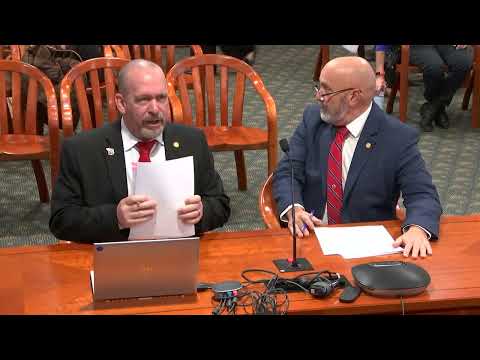
Michigan House Judiciary Committee Hears Industry Push for Harsher Cargo‑theft Penalties
Loading...
Summary
Industry and law‑enforcement witnesses told the House Judiciary Committee that organized cargo theft has escalated in Michigan and urged passage of HB5125 and HB5126 to increase penalties (the bills would add up to 10 years of imprisonment); the committee adopted an H‑1 to HB5125 (7–0–2) and heard extensive testimony but took no further final vote.
The Michigan House Judiciary Committee on Tuesday heard industry and law‑enforcement testimony backing bills that would increase penalties for organized cargo theft and related offenses.
Supporters told the committee that thefts from rail cars, trailers and storage lots have become highly organized and impose direct costs on manufacturers, carriers and consumers. "Last year in 2025, CSX Detroit Intermodal Terminal reported 902 theft ... burglary reports," Paul Brady, supervisory special agent for CSX Transportation Police in the Midwest, told the committee, urging stronger sentencing and coordination with federal partners.
The bills under consideration—HB5125 and HB5126—would increase penalties tied to cargo theft; sponsors described the measure as creating an enhanced punishment of up to 10 years that would be imposed consecutively to existing larceny convictions. The committee adopted an H‑1 amendment to HB5125 by roll call (7 ayes, 0 nays, 2 pass).
Why it matters: Witnesses said cargo theft disrupts supply chains for retailers and automakers, raises insurance costs and can create safety risks for workers. "These are organized groups that are stealing entire cargo loads," a bill sponsor said during opening remarks. Industry witnesses described thefts of electronics and high‑end vehicles, and said recovered goods and criminal investigations sometimes cross state lines.
Industry and carrier witnesses, law‑enforcement representatives and trade groups described the scale and the local impact. Paul Russin, vice president of Auto Warehousing Company, recounted that his firm had 53 stolen vehicles from two facilities in Flint and New Boston over the last five years, with an estimated inventory value just over $3.5 million. "Those numbers pale in comparison to other larger shipping facilities within the state," Russin said, arguing the bills would help deter repeat offenders.
The Michigan Trucking Association’s president and CEO described three main theft types—pilferage, strategic theft and straight theft—and cited national estimates of industry losses. "Cargo theft losses are about $18,000,000 a day," Jill Sokatz told the committee, urging lawmakers to act to protect small carriers that pass costs on to consumers.
Small carriers gave concrete examples. "That was $25,000 out of our pocket for a load of flour," said Ashley Kordish, CEO of Ralph Moe Inc., recounting one incident; she said another theft cost the company roughly $75,500 and that the firm lost about $100,000 overall last year.
Committee members pressed witnesses for comparative data and asked whether enhanced penalties alone would deter theft. Witnesses said prosecutors requested enhanced punishment and stressed the need for better investigative and interagency coordination to address interstate and organized theft rings.
What’s next: The committee adopted an H‑1 amendment on HB5125 but did not take a final vote on the bills during the hearing. Sponsors and supporters signaled an intent to pursue the measures, and the record shows broad industry support from carriers, automakers and law enforcement recorded with the clerk.