
House subcommittee hears MDARD budget briefing; proposed farm start and food-safety investments highlighted
Get AI-powered insights, summaries, and transcripts
Subscribe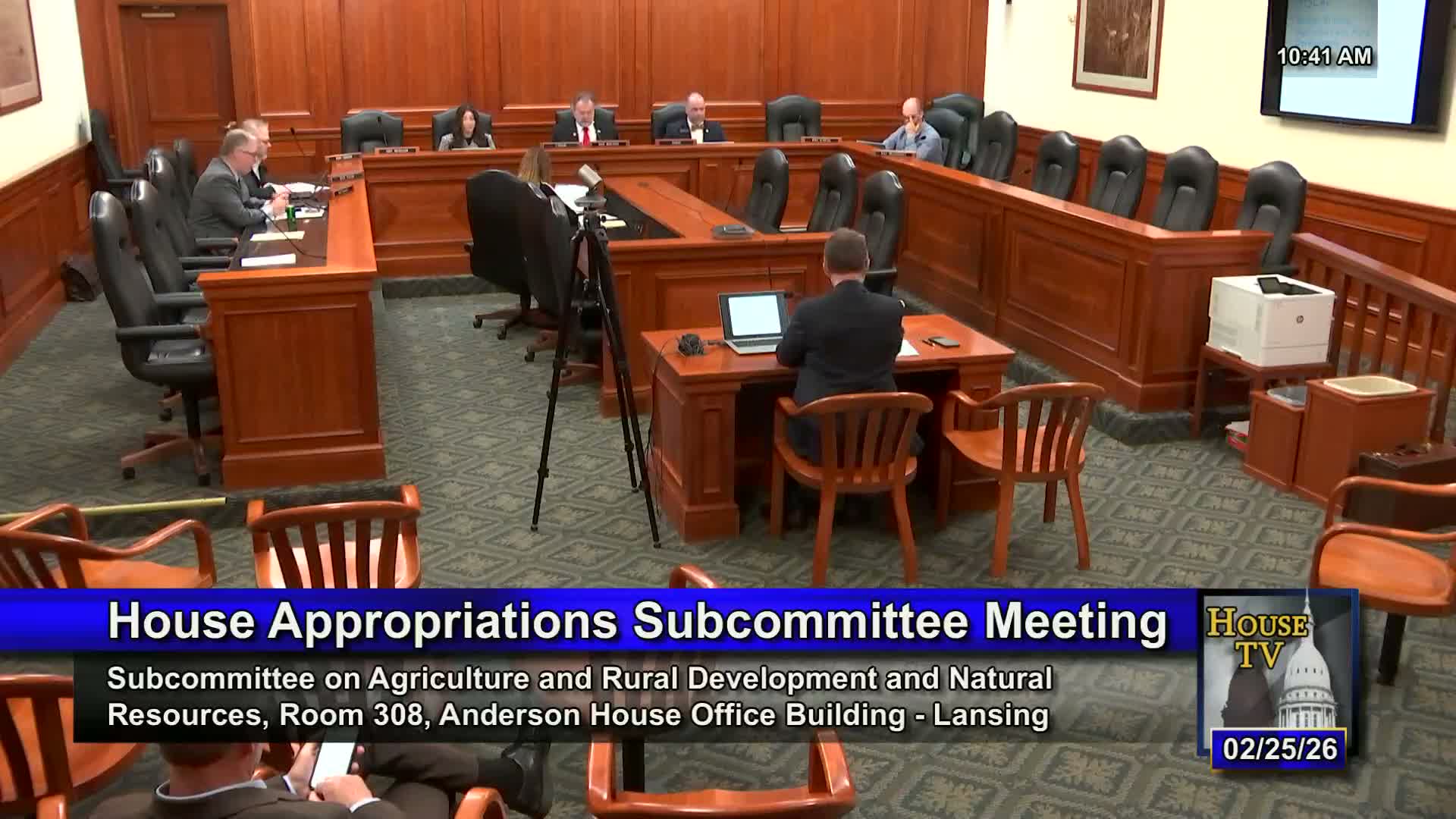
Summary
House Fiscal Agency analyst William Hamilton told the subcommittee the Michigan Department of Agriculture and Rural Development budget totals about $145.9 million with $77.5 million in general fund support; the executive proposal includes a $2 million Farm Start program, $1 million and five FTEs for food-safety enforcement, and a $2 million boost to horse-racing programs tied to internet gaming tax revenue.
William Hamilton, a House Fiscal Agency analyst, told the House Subcommittee on Rural Development and Natural Resources that the Michigan Department of Agriculture and Rural Development (MDARD) has a gross appropriation of about $145.9 million for the current fiscal year and a general fund contribution of roughly $77.5 million. "The appropriation is a $145,900,000. It's a relatively small budget," Hamilton said, placing MDARD at under 1% of the state's total budget and state general fund.
Hamilton outlined four restructured bureaus in the department — Food Safety and Animal Health; Environment and Sustainability; Agriculture Development; and Laboratory and Consumer Protection — and reviewed program funding and statutory authorities. He said MDARD's food-safety programs (including a milk safety and quality assurance program) regulate thousands of processors and retail establishments and are funded by a mix of general fund, state restricted fees and federal dollars. "This program is almost entirely supported by state general fund support," Hamilton said of milk safety, emphasizing the program's role in maintaining compliance with the Pasteurized Milk Ordinance used for interstate sales.
Hamilton identified the animal industry division's bovine tuberculosis containment program as a major ongoing cost and noted recent detections in cattle herds. He summarized historical expenditures for the bovine TB program since 1995 and warned of federal movement restrictions that could follow if Michigan lost a modified accredited status.
On proposed FY2027 changes from the executive budget, Hamilton said the request includes approximately $422,800 for information technology, $1 million and five full-time-equivalent positions to strengthen food-safety and consumer-protection enforcement, and a new $2 million "Farm Start" program with two positions to support new farmers. He described a proposed $2 million increase for horse-racing-related programs that officials expect to fund in part from an earmarked share of internet gambling taxes, and said the rural development grant program is slated to move to the LEO budget.
Members pressed for detail on specific restricted funds. Representative Green asked about the balance and revenue sources for the Agriculture Equine Industry Development Fund; Hamilton estimated an ending balance "about 8 or $9,000,000" and explained that the primary current revenue stream is a capped earmark (about $3,000,000) from the internet gambling tax and smaller sports-wagering receipts, while casino revenues do not flow to the fund. Representative O'Neil asked for clarification about "purse supplements," and Hamilton said the money supplements race purses and breeders' awards and is governed by the Horse Racing Act of 1995; he said distribution details would be provided later.
Hamilton said some one-time items in the current year would be removed in the executive request, with the notable carry-forward of a $1,000,000 one-time appropriation for the Double Up Food Bucks program. He also noted transfers out of MDARD (such as the rural development grant moving to LEO) that affect comparisons between enacted and proposed budgets.
The subcommittee did not take a formal vote on MDARD budget items at this meeting; members requested further breakdowns and accounting of restricted funds, purse-supplement distributions, and line-item detail for programs such as the Ag Equine Fund and food-safety staffing. The committee moved on to the DNR briefing after the Q&A.