Get Full Government Meeting Transcripts, Videos, & Alerts Forever!
Get email alerts on the Natural Hazard Mitigation Plan topic
No spam. Unsubscribe anytime.
Regional natural-hazard plan update spotlights Coginchaug River blockages and invasive-tree losses
Summary
At a RiverCOG public meeting on the regional natural hazard mitigation plan update, residents urged that channel blockages in the Coginchaug River and widespread tree mortality from invasive pests be elevated as top mitigation priorities to preserve access, reduce repeated flooding and qualify for federal funding.
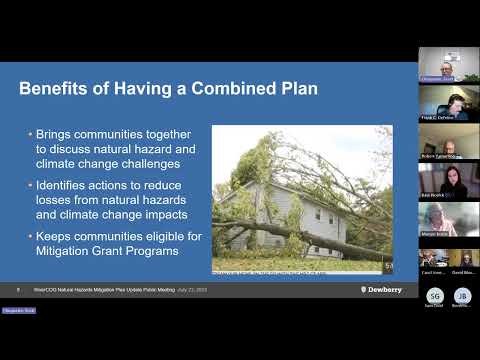
RiverCOG and its consultant team told residents at a virtual public meeting that the regional natural hazard mitigation plan — last adopted in 2021 and due for a five-year update — will incorporate climate-adaptation guidance and community input, including urgent local concerns about the Coginchaug River and invasive-species-driven tree loss.
Sam Gold, executive director of Burbankaug, opened the meeting by explaining the purpose of the update: to maintain eligibility for federal mitigation programs and to identify projects that reduce future losses. "Readoption every five years keeps communities eligible for certain forms of hazard-mitigation assistance," he said.
Consultant Scott (Dewberry) described the process and funding programs tied to an adopted plan, including the FEMA Hazard Mitigation Grant Program and the Flood Mitigation Assistance program. He noted the state serves as grantee and that local and regional governments generally participate as subgrantees under a typical 75/25 cost share. "Those grants are not limited to the impacted area — RiverCOG can apply for funding even if it wasn't directly impacted by a particular event," Scott said.
Public commenters pressed the team to recognize river-channel obstructions as a regional priority. Frank DeFelice, chair of Durham's Planning and Zoning Commission and the town's Inland Wetlands and Watercourses Commission, said the Coginchaug River is choked with fallen trees and log jams and that the condition has produced repeated road closures and property impacts. "It must be cleaned," DeFelice said, adding that aerial photos dating to 1935 show the channel has shifted and that state action has been insufficient.
A Middlefield representative described a separate local vulnerability: a single point of entry to a Bezek Lake neighborhood that would leave roughly 200 households without road access if storm damage severed the access road. The resident said that in some cases boat evacuation would be the only option.
Several participants described extensive tree mortality from emerald ash borer, fungal disease and other pests, and argued the resulting canopy loss is worsening channel blockages and public-safety risks. "The number of trees that are down'' is unbelievable," one resident said; another urged specific actions in the plan for targeted tree removals and reforestation.
RiverCOG staff and consultants responded that invasive species and hazardous trees are already listed in the hazard inventory and that the update will expand treatment options and mitigation strategies. Margo Burns (RiverCOG project manager) and the consultants pledged to review the 2021 plan's mitigation strategies related to tree removal and to consider stronger, more specific actions where warranted.
The team also said it will add an extreme-heat component to the update and incorporate recent local resiliency projects (including Resilient Connecticut work in East Haddam and Portland) into the regional plan to help build a pipeline of fundable proposals. David Murphy (Resilient Land and Water) said folding in recent projects can position them for federal grants.
Next steps include a summer online survey (open about three months), follow-up local meetings to present the risk and vulnerability assessment results (targeted for autumn/winter), and a subsequent round of workshops to develop the mitigation strategy. The consultant said drafts will be posted for public comment and then submitted to the state and FEMA for review and approval.
Participants asked for outreach materials for town newsletters; Middlefield requested a blurb by Aug. 15 for a Sept. 5 publication. The consultant agreed to supply short outreach copy and to distribute drafts of the invasive-species section for local review.
The meeting closed after participants thanked the team and reiterated the request that the plan explicitly address Coginchaug River channel clearance, invasive-species management, and specific local access vulnerabilities as fundable mitigation priorities.