Get Full Government Meeting Transcripts, Videos, & Alerts Forever!
Get email alerts on the Land Use Market Feasibility topic
No spam. Unsubscribe anytime.
Don Poland urges Connecticut planners to align zoning with market realities
Summary
Don Poland, a planner with Gomen York Property Advisors, told the CROG Regional Planning Commission that plans and zoning should account for market feasibility—citing downtown office vacancy up to about 50%, typical thresholds for new construction rents, and the role of flexible zoning in lowering developer risk.
Don Poland, a planner with Gomen York Property Advisors, told the CROG Regional Planning Commission that town plans and zoning must reflect real market constraints if communities want development proposals that are feasible.
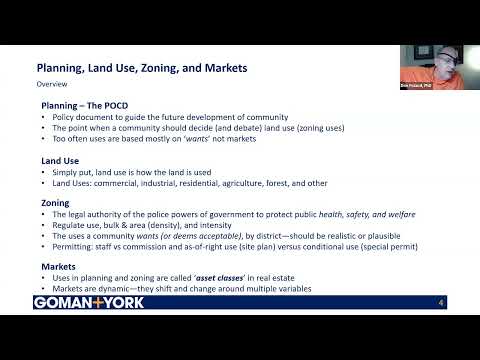
Poland told commissioners that the plan of conservation and development (POCD) is the right place to discuss desired uses and the extent to which the local market can support them. "Housing is economic development. Housing is where jobs go at night," he said, arguing that communities should match aspirations to market realities rather than treating zoning as the moment to resolve use debates.
Why it matters: Poland said market feasibility—whether enough demand exists—and financial feasibility—whether a project can attract equity or debt—drive whether a proposal will be built. He warned that permitting processes that route most projects through public hearings can shift investment toward areas of least resistance and deter reinvestment in places with slower, more cumbersome reviews.
Key evidence and examples: Poland cited local and national trends. He said downtown office vacancy rates in the Hartford region are "as high as 50%" in some central business districts and about 20% or higher in some suburbs. He described a simple threshold for new construction: communities often use about $30 per square foot as a break point for supporting new commercial construction; in his worked example a 50,000‑square‑foot retail building with total development costs would require roughly $35 per square foot to provide acceptable returns—above a hypothetical market rent of $25 per square foot—and so would likely be infeasible without subsidy or cost reductions.
Poland used regional examples to show how location changes over time: older downtown retail can be supplanted by regional centers and mixed‑use developments that draw a wider market. He also described geofence analyses that show trade areas and short, frequent retail visits—"the person running in the Starbucks"—which underscore the continuing role of convenient parking and accessibility for certain retail types.
Recommendations and tradeoffs: Poland urged commissions to consider flexible zoning techniques such as master plans, phased approvals and overlay districts that allow earlier review of use concepts without forcing developers to pay for full design and traffic studies up front. He said that flexible approaches can reduce developer risk, shorten timelines and improve the odds a proposal is deliverable for the community.
Exchanges during Q&A: Commissioners raised questions about trust between developers and communities, planning for public facilities and sustainable development within a growth economy. Poland acknowledged distrust is real, and said it often stems from the high upfront costs and market risk developers absorb: "It's not about greed," he said, noting developers require higher returns because development carries substantial risk. On public facilities he noted that while libraries and schools are public goods and have different objectives, municipalities still face renovation and replacement costs as buildings age. Responding to a question on sustainability, Poland recommended more infill and adaptive reuse but highlighted demolition and remediation costs—on the order of roughly $10–$20 per square foot—that must be accounted for in redevelopment pro formas.
Next steps and provenance: Poland said he would share slide data and take follow‑up questions by email; he confirmed he had sent the deck to staff. (Presentation runs in the transcript from SEG 056 to SEG 1213.)