Get Full Government Meeting Transcripts, Videos, & Alerts Forever!
Get email alerts on the Active Transportation topic
No spam. Unsubscribe anytime.
CROG launches Priority Pathways study to knit bike and pedestrian network across 38 towns
Summary
The Capital Region Council of Governments launched the Priority Pathways study to identify a regional network of walking and biking routes, prioritize safety improvements and coordinate funding and municipal actions; the plan runs through mid‑2026 and will include community outreach and site audits.
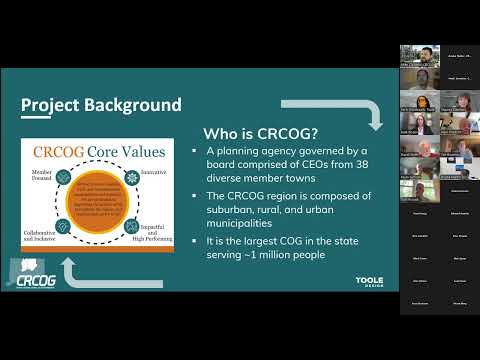
Mike Cipriano, Principal Transportation Planner with the Capital Region Council of Governments (CROG), and consultants on Wednesday opened the first public meeting for CROG’s Priority Pathways study, a regional effort to identify walking and bicycling routes and prioritized safety investments across CROG’s 38 member municipalities.
The study, led by CROG staff with consulting support from Toole Design and Foursquare ITP, aims to produce a prioritized network, implementation strategies and short‑ and long‑term actions, including a Complete Streets policy review and identification of potential funding streams. Cipriano described the work as driven by safety concerns: recent injuries and fatalities involving vulnerable road users have made better infrastructure a top priority.
"We want to develop a prioritization plan which will help identify locations or corridors that could benefit from having better facilities or infrastructure to make it safer for these users," Cipriano said. The team emphasized that the network will serve both recreational and utility trips and "suit those from ages 8 to 80," in the words of Shauna Kitzman, Connecticut market lead for Toole Design.
Consultants reviewed early engagement results: live polling showed that while driving remains dominant, walking and biking have substantial participation, and participants ranked better connections to destinations, new bicycle and pedestrian infrastructure, and intersection improvements (crosswalks and signal upgrades) among the highest needs. Municipal outreach in March included 10 virtual focus groups; consultants reported participation from 34 of CROG’s 38 municipalities and an advisory committee of about 15 members representing public‑health, trails, state DOT and local planners.
Kitzman laid out a schedule that began in 2024 and aims to finish in June 2026. Near‑term public engagement will include pop‑ups and events such as Parkville Market (May 10), regionwide Trails Day activities, Juneteenth in Bloomfield and site audits in employment corridors like Day Hill Road in Windsor. The team said dates and outreach locations will be posted on the project web page once finalized.
Residents who spoke near the close of the meeting urged practical support for town‑level advocacy and cross‑town connections. Patrick Thibodaux of Enfield asked for guidance on creating a local bicycle/pedestrian advisory committee, saying he “doesn’t know where to start.” An attendee who identified themself as president of BikeWalk Glastonbury recommended partnering with a town engineer and town board to advance projects. Ed Pollack, chair of the West Hartford Pedestrian and Bicycle Commission, asked whether the study would identify "those places where with just a little bit more infrastructure" communities could eliminate choke points at municipal boundaries; consultants confirmed regional continuity and filling small gaps is an intended outcome.
Resident David Smith of West Hartford described adaptive cycling on a trike after a health setback and thanked the team: "what you're doing is very helpful," he said, underscoring the project’s accessibility goals.
The CROG team said it will post meeting materials and the recording on the project web page and hold at least one more public meeting later in the process. The study will feed into an implementation plan that identifies funding options and a timeline for realizing prioritized corridors across the Hartford region.