Get Full Government Meeting Transcripts, Videos, & Alerts Forever!
Get email alerts on the Land Use Statutes topic
No spam. Unsubscribe anytime.
Regional planners briefed on 2024–25 land-use changes as state readies climate and housing rules
Summary
Attorney Mike Ziska told the Regional Planning Council that Public Act 25-33 adds climate vulnerability and resilience requirements to municipal plans by Oct. 1, 2027, and that the vetoed Public Act 25-49 contained controversial middle-housing and affordable-housing mandates likely to return in altered form.
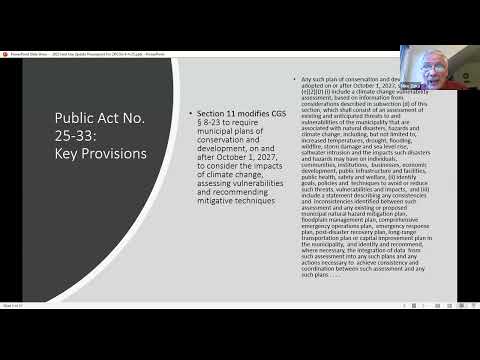
Attorney Mike Ziska of Halloran & Sage told the Central Regional Council of Governments at its Feb. 25 meeting that recent state legislation requires municipalities to begin incorporating climate-change vulnerability assessments and resilience strategies into their plans of conservation and development.
Ziska described Public Act 25-33 as adding multiple planning requirements, including an October 1, 2027 deadline for plans to include climate-vulnerability assessments, maps that reflect threatened areas and recommended land uses, geospatial data to convey risk, and identification of infrastructure critical for evacuation and sustaining quality of life during disasters. He said the statute encourages regions to provide technical support but contains few direct penalties for noncompliance.
On the housing front, Ziska reviewed provisions of Public Act 25-49, which the governor vetoed. He said the act would have required zoning to allow certain types of ‘‘middle housing’’ as-of-right on many commercial lots, limited the ability to deny applications for lack of off-street parking except where a specific adverse health or safety impact is demonstrated, changed protest-vote thresholds for zoning amendments, and created a process requiring certain municipalities to prepare priority affordable housing plans tied to state allocations. Ziska told the council these features were likely the source of strong municipal opposition.
He cautioned that although some provisions lack immediate enforcement mechanisms, the state could use discretionary funding priorities as a ‘‘soft hammer’’ to favor towns that adopt the recommended plans and tools. He urged regional councils of governments to develop shared resources and tools to help member municipalities meet the new planning requirements.
The presentation materials will be shared with members and the presenter offered to correct typos in the slides before distribution. The council voted to adopt the previous meeting minutes during the session and closed the presentation before moving to other business.