Get Full Government Meeting Transcripts, Videos, & Alerts Forever!
Get email alerts on the Annual Performance Report topic
No spam. Unsubscribe anytime.
Springfield Public Schools posts APR gains; principals credit PLCs and targeted interventions
Summary
Superintendent and academic leaders presented FY25 Annual Performance Report showing district APR gains (FY25 APR 83%, up 4.8 points from FY24). School leaders from elementary through high school credited professional learning teams, RTI cycles and protected intervention time for recent gains.
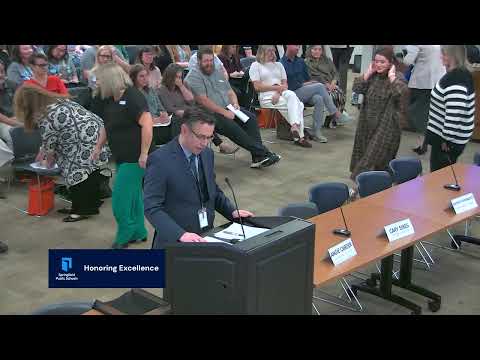
Springfield Public Schools leaders on Tuesday told the Board of Education that the district’s FY25 Annual Performance Report shows measurable gains and pointed to school-level practices that drove the improvements.
Dr. Nicole Holt, executive director of academics, said the district scored 166 out of a possible 200 APR points for FY25 — "which puts us at an APR of 83%" — an increase of 4.8 points from FY24 and a 7.5-point gain over a three-year span. Holt said math and science showed accelerated gains and the district secured two attendance-related APR points as a result of improved attendance efforts.
The presentation included breakdowns by assessment type and student groups. Holt noted that 10 of 11 student groups saw year-over-year increases and highlighted a 6% ELA gain for Black students and a 5.6% science gain for Hispanic students. She also cautioned the board that proficiency levels (often in the 40–50% range by content area) remain a priority: "Are we satisfied with 42 to 47% in any given content area scoring proficient or advanced? No. We are not," she said.
Principals and teachers from dozens of schools described practices they say produced growth: protected intervention blocks in master schedules, weekly professional learning team (PLT) meetings, use of common formative assessments (CFAs) to form needs-based groups, and in-school "Win Time" (RTI) sessions to reteach or extend standards. Adam Meador, principal at Bingham Elementary, summarized Bingham’s approach: "Together, teamwork, community, and consistency are the foundation of Bingham's continued growth." Wanda Gray Elementary leaders described MAP boot camps and RTI cycles that drove a third- to fourth-grade cohort ELA increase from 53% to 70%.
High school principals reported large EOC gains in multiple subjects. Glendale High School leaders said EOC proficiency in four tested areas rose more than 20% over three years, crediting cross-building collaboration, librarians supporting book clubs and access to printed curricular materials. Parkview, Hillcrest and other high schools described daily or weekly RTI blocks that targeted students who were near proficiency and used intentional, short-cycle assessments to bump students up a level.
A member of the public, Carl Hurd, used the public-comment period to question assessment construction and graduation practices, contending that "easier tests produce higher test results" and that lowering standards can raise graduation rates; the board did not debate those comments during the meeting.
The board asked district leaders to continue focusing on professional development, curriculum fidelity and monitoring to push proficiency higher. Dr. Holt told board members that professional learning communities and consistent, job-embedded professional learning were the combination most responsible for the fidelity gains the district has recorded.
The presentation closed with district-level implementation metrics: Holt reported more than 700 site visits by executive directors/directors this year and over 3,000 teacher feedback forms entered into the district system, and cited partnerships with Benchmark and Solution Tree to support selected campuses.