Get Full Government Meeting Transcripts, Videos, & Alerts Forever!
Get email alerts on the Student Assessments topic
No spam. Unsubscribe anytime.
Gaylord schools report winter assessment gains; preschool-to-district continuity at 89%
Summary
District presenters told the board winter NWEA results show building- and grade-level growth (many schools in the 60th–70th percentile for growth) and reported that 89% of last year’s preschool cohort continued in Gaylord Community Schools.
At a regular board meeting, presenters reviewed winter assessment results across Gaylord Community Schools, reporting measurable gains in growth and achievement and high preschool-to-district continuity.
Presenters said building-level growth on NWEA assessments was often in the 60th percentile range, with some grade-level pockets reaching the 70th percentile for growth. "The number came up to 89%" of last year’s preschool children continuing in the district, a presenter stated, noting that four repeat preschoolers kept the rate just under 90%.
School-level reports showed South Maple’s reading growth in the 60th percentile with achievement rising from roughly the 40th to low-50s percentile; math growth was reported near the 70th percentile and achievement improved to about the high-50s percentile. A presenter clarified the metrics: these figures are NWEA percentiles (comparisons to national peers), not raw test-percentage scores.
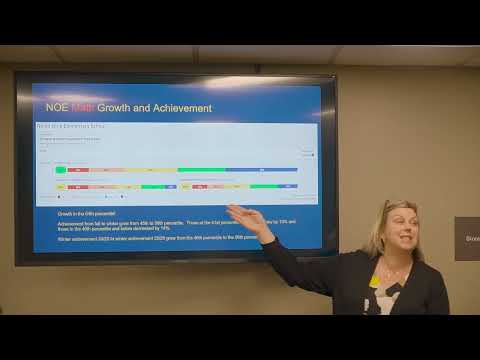
North Ohio showed similar trends: reading growth around the mid-60s percentile and achievement improving from about the low-40s to about the 50th percentile; the share of higher-performing students rose roughly 11% while lowest-performing students declined by about 13%. Grade-level breakdowns showed seventh-grade reading growth near the 69th percentile and eighth-grade gains accompanied by reductions in lower-performing groups. An algebra subgroup recorded particularly high growth, attributed in part to a new test format for that cohort.
At the high school, the mid-January semester change correlated with an 11% decrease in failure rates compared with 2024–25: presenters said that equaled about 120 fewer failed classes and 20 fewer students failing three or more classes. Staff have launched ARC peer-to-peer tutoring as a targeted response.
Board members and presenters said the district will collect spring assessment data to provide an additional comparison point and will focus interventions on students in the "yellow" band who are nearest proficiency.
The board heard these updates as part of the building reports and did not take any formal action on the assessments. The next data update was described as planned for late spring.