Get Full Government Meeting Transcripts, Videos, & Alerts Forever!
Get email alerts on the Data Transition topic
No spam. Unsubscribe anytime.
Field staff shown a quick method to map WIMS breakpoints to FEMs during transition
Summary
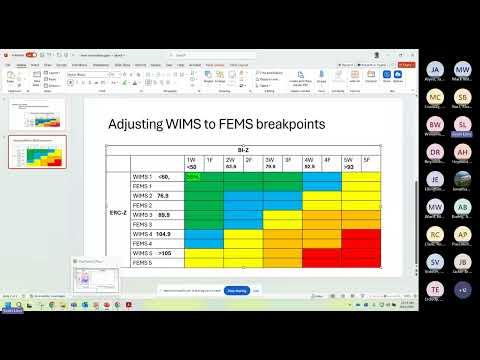
A webinar trainer walked dispatch staff through a step-by-step method to map legacy WIMS breakpoints to FEMs percentiles, provided an interim Excel tool, and urged units to match old analysis settings initially until a full reanalysis can be completed in fall/winter.
A technical webinar for fire dispatch and planning staff explained how units can translate legacy WIMS (FW13) breakpoints to the new FEMs (Fire Family Plus) breakpoint framework using a simple, interim method based on climatology percentiles.
The presenter said participants should have three items ready: a copy of their current dispatch operating plan (FDOP), the FW13/WIMS database that produced those breakpoints, and a blank FEMs default (version 3) database downloaded from the FEMs web portal or the NFDRS SharePoint on FireNet. He demonstrated opening the old WIMS dataset and the blank FEMs database side by side in Fire Family Plus and running simple climatology graphs for ERC and burning index (BI).
"You want to run the same climatology in the old dataset and then run it in the FEMs dataset and find the percentiles that correspond to your old breakpoints," the presenter said, demonstrating how an old BI breakpoint of 50 mapped to roughly the 56th percentile in his example and how to enter that interim value into dispatch sheets. He characterized the process as a "down-and-dirty" interim approach to keep dispatch units operational during the transition and stressed it was not a substitute for a full reanalysis.
The presenter advised keeping analysis settings consistent with prior practice for the initial transition (for example, using the 1300-hour reports rather than switching immediately to daily extremes) so percentiles remain comparable. He also outlined how to re-run using a full seasonal analysis window (for example, 2005–2022) when units are ready to complete a full reanalysis.
An interim Excel workbook the presenter built can query multiple stations, pull climatology records, and output percentiles for dispatch matrices; he cautioned that the workbook is not intended to replace a proper reanalysis and may require users to build multiples of the sheet for units with many stations.
The presenter encouraged units to test results locally and to contact the team with cases where the method or workbook produces unexpected values. He said the group will continue discussions and provide documentation and the spreadsheet when ready.