Get Full Government Meeting Transcripts, Videos, & Alerts Forever!
Get email alerts on the Peru Pilot Screening topic
No spam. Unsubscribe anytime.
Duke pilot uses pocket colposcope and self‑HPV testing to expand cervical cancer screening in Cajamarca, Peru
Summary
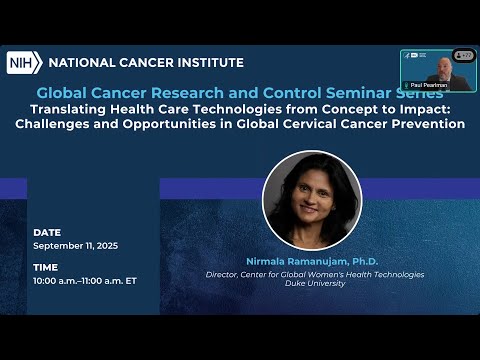
At an NCI seminar, Dr. Nimmi Ramanujan described a USAID‑funded pilot that reached more than 4,000 women in Cajamarca using self‑sampled HPV testing, kiosks, a pocket colposcope and telemedicine; about 15% tested HPV‑positive and 78% completed treatment, she said.
Duke University researcher Dr. Nimmi Ramanujan told a National Cancer Institute seminar that a technology‑enabled screening program in Cajamarca, Peru, combined self‑collected HPV testing, community outreach, a pocket colposcope and telemedicine to bring triage and treatment closer to women in remote communities.
The pilot—funded in 2018 through a USAID grant—was implemented with local partners led by Dr. Patty Garcia at the University of Cayetano. Ramanujan said the team launched the program in four primary clinics and used community health workers and midwives to promote self‑sampling and deliver point‑of‑care procedures. "We launched this program in 4 clinics, within Cajamarca," she said, describing a workflow in which women drop samples at a clinic kiosk, samples are batch‑tested at a central laboratory and positive results trigger app‑based appointment scheduling for imaging and follow‑up.
Ramanujan reported that the pilot enrolled "4,000 plus" women who self‑collected HPV samples; about 15 percent tested positive, roughly 78 percent of HPV‑positive women completed treatment in the primary clinics, and approximately 19 percent were referred to higher‑level care. She noted that Peru adopted a policy for HPV self‑sampling in 2017 and began wider procurement of HPV tests (cobas) in 2024, which helps sustain such programs.
The project emphasized a continuum of care: images and patient data were uploaded to a web server for clinician review, midwives performed thermo‑coagulation treatment when appropriate, and suspected cancers were referred to tertiary centers. Ramanujan said the model aimed to shift triage away from multi‑visit clinic pathways toward community and primary‑care settings, reducing travel burden and reliance on scarce specialists.
On commercialization and product design, Ramanujan said translating academic prototypes into durable, manufacturable devices required industry partners to address cost‑of‑goods and ergonomic issues. "The company had the resources and ability to be nimble and address those types of issues," she said, citing an example where handle/button placement had to be redesigned for midwives' hand sizes in Peru.
Ramanujan cautioned that the program faced operational challenges—sample transport, intermittent Internet for telemedicine, and provider acceptance—and said continued scale‑up relies on clinician training, supply procurement and stable laboratory workflows. She described the pilot as an example of a systems approach that pairs point‑of‑care technology with community engagement and referral pathways.
The seminar discussion noted remaining questions about exact age ranges enrolled (Ramanujan said screening followed standard guideline ranges, approximately ages 25–65) and the need for expanded trials to test self‑use versus clinic exams. The session closed with links to NCI event resources and plans for additional studies.