
Kane County finance committee presses for clearer accounting after treasurer flags report discrepancies; dozens of procurement cards approved
Get AI-powered insights, summaries, and transcripts
Subscribe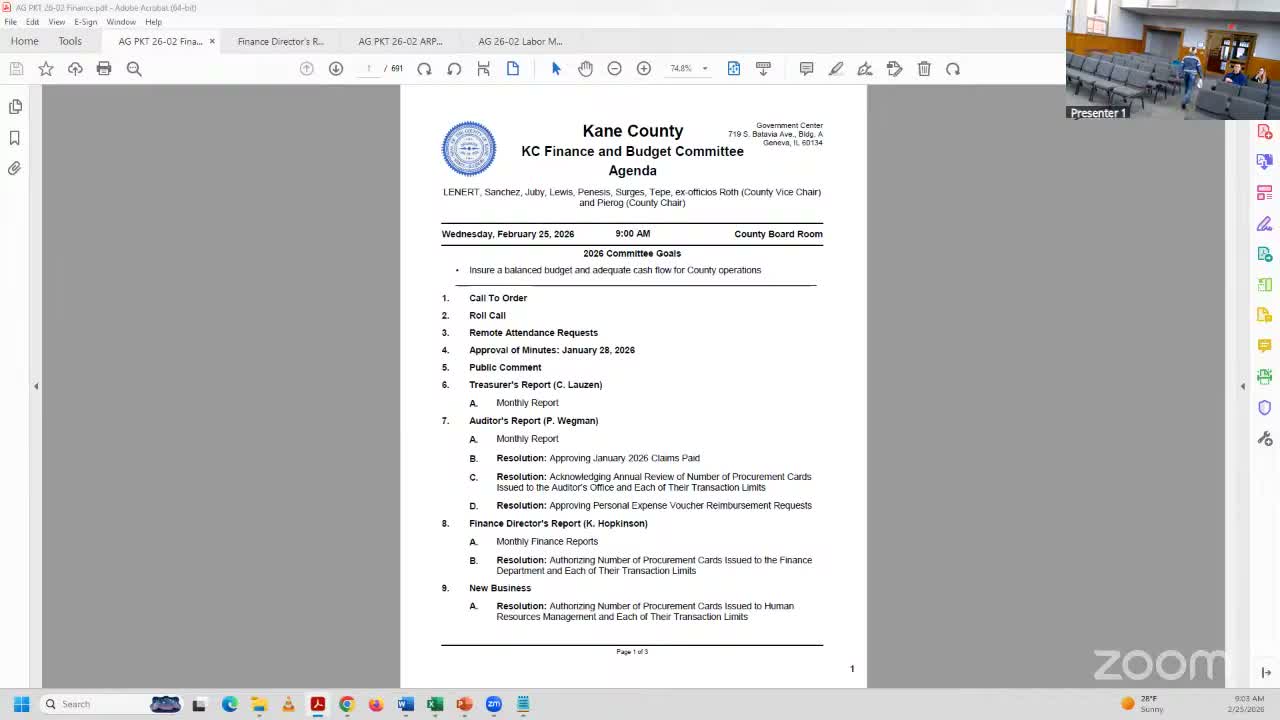
Summary
At a Feb. 25 Kane County Finance & Budget Committee meeting, the treasurer flagged inconsistencies between monthly management reports and audited statements, the county auditor recommended a Menards-rebate policy, and members approved an emergency purchasing ordinance plus more than 20 procurement-card resolutions and several grants and intergovernmental agreements.
Kane County's Finance & Budget Committee met Feb. 25 and heard a series of reports that prompted members to demand clearer accounting practices, while approving an ordinance to speed emergency purchases and more than 20 department procurement-card authorizations.
Treasurer Mister Lawson told the committee he found what he called large discrepancies between monthly management reports and the annual audited figures, saying one report showed general fund interest income "18% underperforming" against budget while cash-on-cash reconciliations and bond valuations reflected significant gains. "What should happen with interest income ... is that it's aggregated rather than spread out," Lawson said, arguing the current practice spreads interest across hundreds of funds and can obscure real fund performance.
Committee members pressed Lawson for specifics about why monthly management reports and the annual comprehensive financial report (ACFR) do not tie out. Mister Gripe said the variation was concerning: "If this was my tax return, I'd be sitting in jail," and asked how numbers could be so far off. Lawson replied the difference reflects reporting and bookkeeping practices rather than cash differences and recommended reconciling monthly reports to the ACFR: "You need to insist on them tying out to the county audits," he said.
County Auditor Miss Wegman presented a Menards rebate audit and told the committee there is no uniform county policy governing vendor rebates, creating inconsistent handling and missed funds. Wegman recommended a petty-cash–style policy with documentation so rebates are tracked and returned to the appropriate departmental budgets. Members asked the state's attorney's office to draft a rebate-handling policy for committee review.
Finance Director Miss Hopkinson reviewed year-end figures for 2025 and explained the county's accounting practice of allocating interest earned to funds based on month-end cash balances. She said the county earned approximately $22.7 million in interest in 2025 and that roughly $6 million in transfers (subsidies) went into the general fund that year. Hopkinson also noted an annual ARPA-related interest transfer of about $1.5–2.0 million that will wind down by 2027.
On procurement and emergency purchases, the committee considered ordinance 26-137 to amend county code section 2-212 to allow the director and the director of emergency management to approve purchases between $10,000 and $30,000 without competitive bidding during declared emergencies. Members asked for clearer definitions of "emergency" or "disaster" to avoid confusion; the state's attorney advised language can be clarified and the chair noted the office endorsed the draft. The ordinance passed by roll call.
Members also resolved a practical gap between the ordinance and procurement-card limits: many department procurement cards are set with single-transaction caps of $29,900, while the emergency authority in the ordinance reaches $30,000. Committee members discussed temporary limit increases and combining departmental cards to accommodate genuine emergency spending. Finance staff said purchasing can temporarily raise card limits for a month to cover large emergency expenses and then restore prior limits.
After a motion to reconsider, the committee amended and approved resolution 26-136 to raise the single-purchase and monthly credit limits on a specific emergency-management procurement card (Scott Bizekhi) to a $29,900 single purchase and a $45,000 monthly credit limit.
Votes at a glance: the committee approved auditor items including claims paid of $14,630,432.75 (res. 26-270) and a $196.91 reimbursement (res. 26-272); accepted a $50,000 AOIC modernization grant (res. 26-181); approved a $100,000 DCEO tourism marketing partnership grant as amended (res. 26-231, amended); approved two intergovernmental juvenile-detention agreements at $225/day for three years (res. 26-151 and 26-185); and advanced more than 20 departmental procurement-card authorizations (multiple resolutions, various limits). The emergency purchasing ordinance (26-137) was approved as well.
The chair said the committee will work with the state's attorney and finance staff to produce clearer language and recommended procedures for emergency purchases and better reconciliation practices between monthly management reports and the ACFR. The committee also asked staff to draft a rebate policy for review. Members discussed 2027 budget planning and said they aim to have a proposed budget outline by mid-summer after consultations with elected officials and department heads.
The committee adjourned after placing the reports on file and agreeing to follow up on the accounting reconciliations, the rebate policy, and procurement-card procedures.