Get Full Government Meeting Transcripts, Videos, & Alerts Forever!
Get email alerts on the Zoning topic
No spam. Unsubscribe anytime.
Newburgh board tables special-use requests from Optimal Access after neighbors raise safety and signage concerns
Summary
The Town of Newburgh Board of Zoning Appeals delayed decisions on two related special-use requests from Optimal Access — to use a residential R-1 lot for school activities and to retain a large art installation that town staff says meets the definition of a sign — after extended public comment about traffic, privacy and whether the work is art or advertising.
The Town of Newburgh Board of Zoning Appeals on Feb. 25 deferred decisions on two requests from nonprofit Optimal Access tied to its Access Academy program after residents raised safety, privacy and signage concerns.
The applications under review were (1) a conditional-use request to allow school activities on an adjacent R-1 (residential) lot behind the academy building, and (2) a special-use permit to allow an above-ground art installation—bearing the organization’s name and a scannable QR code—on that same residential parcel. Town staff told the board the two applications are related and recommended hearing them together.
Dr. Dukes, the property owner who hosts the school building, told the board he was “very proud of what they’re doing,” and said he could not understand why the installation would offend neighbors. Casey DePries, identified in meeting materials as CEO of Optimal Access and head of Access Academy, told the board the project was funded with an Indiana Arts Commission grant and designed by students. "It was never intended ever to be a commercial sign," DePries said, adding the work is meant to be interactive and to help students share stories.
Neighbors—several of whom live immediately adjacent to the trail and the residential lot—disputed that characterization. Bria Ostrud, who lives across from the installation, said it faces her home and accused the organization of creating an intrusion on residents’ privacy: “I have a feeling of infringement on privacy,” she said, and also reported trash and loitering near the trail. Other residents flagged pedestrian and vehicle-safety concerns at the crossing where students would access the trail, questioned the durability and maintenance of the materials, and warned that allowing the piece to remain could set a precedent for commercial-style signs in residential areas.
Town staff explained a complicating legal point: while the municipal code (cited in the meeting as Ordinance 1997‑1 / code reference 157‑01) permits permanently anchored lawn furnishings, statues and art in residential and commercial districts, the town’s definition of a “sign” focuses on the physical face and mounting. Because the installation has a sign-like face on posts and includes the organization’s name, staff concluded it met the ordinance definition of a sign and therefore required conditional-use review in an R-1 district. Staff also cautioned that parts of the installation might lie in a CenterPoint utility easement; the town does not police utility easement content and any removal requirement would be enforced by CenterPoint.
Residents raised additional allegations about the installation process: a public commenter said contractors had promised replanting that never occurred and accused installation teams of later adding elements contrary to statements made to neighbors. The applicant’s representatives replied they would replace weathered pieces and maintain the work; they also said volunteers installed parts of the display during a community volunteer day.
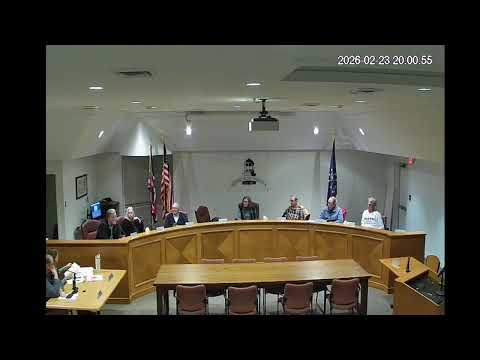
During deliberations a board member moved to approve the conditional use to allow school activities on the residential parcel, and a second was recorded. Before a final zoning vote, however, another member made a motion to table the matter for further review. After a roll‑call on the motion to table, the board voted to table the school-use special use; the board also voted to table the separate sign/special-use item. Both matters were carried over to the next BZA meeting, scheduled for March 23.
The board’s packets included a staff report and remonstrator comments; board members asked staff to supply a copy of the municipal sign definition and related code language and to confirm any CenterPoint easement alignment with a survey. The board also discussed possible mitigations (relocating a bench, altering wording on the piece, using different materials, or moving a display onto the commercially zoned frontage) as potential compromises for the applicant and neighbors.
The board took no final action on either special-use application; both items are scheduled for further consideration at the next meeting.