Committee Hears Support for Bill to Create Constitutional Floor for Parental Rights
Loading...
Summary
Witnesses and experts urged the Civil Rights and Judiciary Committee to advance House Bill 27-35, which would codify a 'constitutional floor' in family law (called 'Troxell 2' in testimony) to reinforce a presumption of parental fitness and require reviewable findings before severely restricting parental rights. No vote was taken at the hearing.
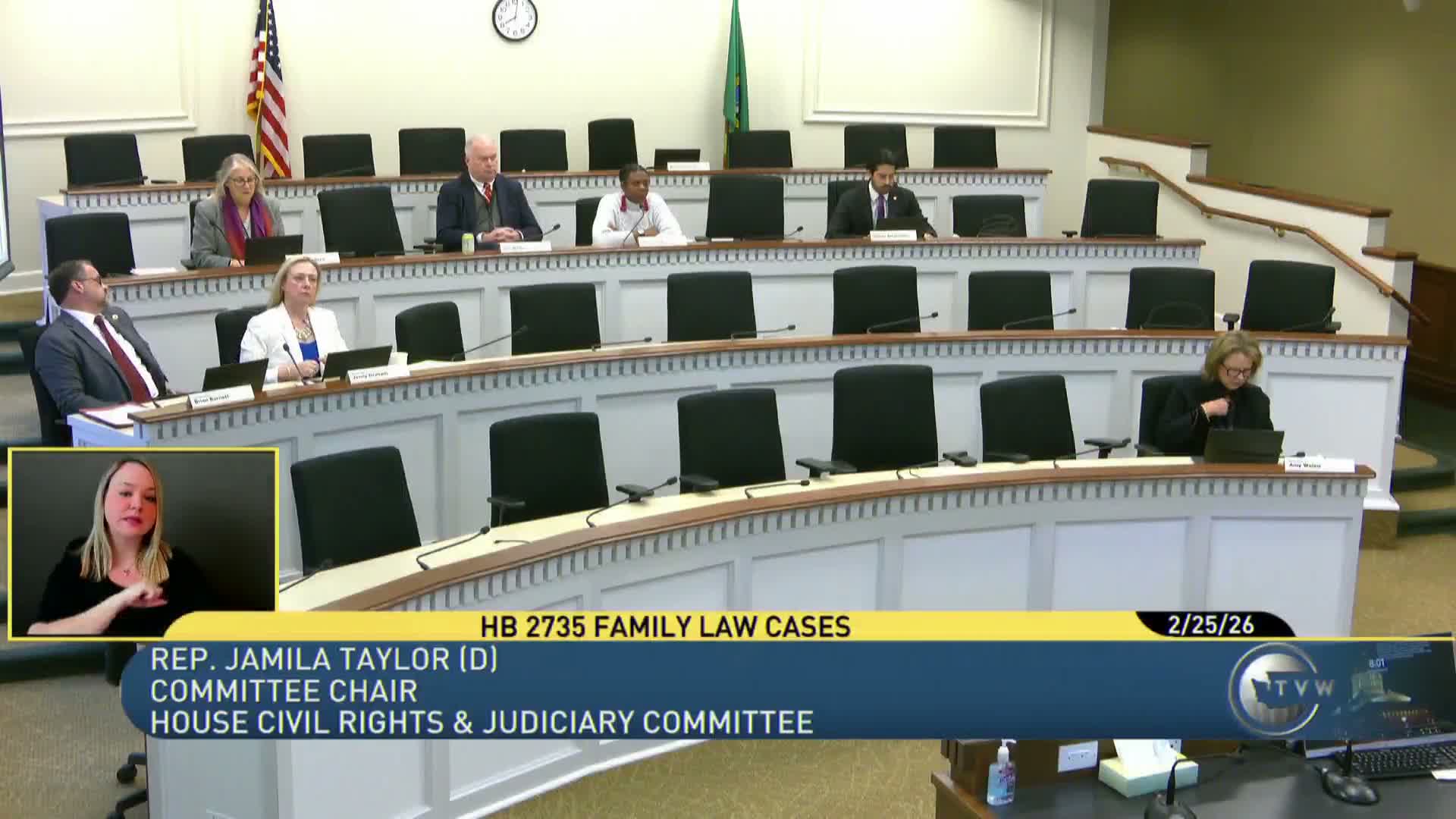
The Civil Rights and Judiciary Committee heard public testimony Feb. 25 on House Bill 27-35, a proposal to establish a statutory 'constitutional floor' for parental rights in Washington family-law proceedings. Staff described the measure as adding legislative intent language to RCW chapter 26.09 to emphasize a presumption of parental fitness, equal standing for similarly situated parents, and a duty to cooperate.
Representative Rob Chase, prime sponsor, framed the bill as following the constitutional principles recognized by the U.S. Supreme Court in Troxel v. Granville and said the measure (referred to in testimony as 'Troxell 2') aims to reduce costly, prolonged litigation and the harm it causes to children. "I think Troxell 2 would get rid of a lot of the pain in these family law situations," Chase said.
Several parents who described extended, adversarial cases told the committee that current processes can remove meaningful contact between fit parents and their children. "It generated nearly 700 filings, multiple appeals," said testifier Jack Loop of Seattle, who described a long dissolution that resulted in restrictive orders he said were applied without meaningful review. Sean Kollmeyer, another father, said statutes intended to protect children have been "manipulated and misused" to limit access for fit parents, and that he has not seen his son in almost seven years despite no criminal findings against him.
Other witnesses urged the committee to view the bill as structural reform rather than a partisan proposal. Dan Sturtevant, author of the Troxell 2 manuscript, told lawmakers the bill proposes system-level 'stabilizers' — a fit-parent presumption, uniform standards, strict scrutiny with least-restrictive-means for material burdens on the parental bond, limits on delegation, and transparent, reviewable findings — to reduce unpredictable and costly litigation. "A rights floor makes the system more stable and more administrable," Sturtevant said.
Shannon Draun, founder of the Due Process Project and a contributor to the Troxell 2 model code, said the bill would not remove domestic-violence protections and would instead make protective interventions more reliable by requiring reviewable evidence and uniform statewide standards. "These are not new rights," Draun said. "They are the minimum constitutional baseline that makes state power principled, consistent, and reviewable."
Supporters from fathers' advocacy groups and the National Parents Organization urged presumptive shared parenting when both parents are fit and urged limits on early case-management orders that can calcify restrictive schedules. Jim Clark, chair of the National Parents Organization in Washington state, cited research he said supports 50/50 custody outcomes and offered a written estimate of statewide costs tied to current practices; Clark's numerical estimate and supporting paper were provided in his written testimony.
No formal committee vote on HB 27-35 occurred during the public hearing. Chair Taylor closed the public testimony portion and encouraged submitters to provide written comments by email for committee consideration. The committee then proceeded to an executive session to consider other bills.
Why it matters: Supporters say HB 27-35 would increase procedural safeguards and consistency across counties, potentially reducing litigation costs and restoring parent-child relationships. Opponents did not appear in the public record at this hearing; committee members asked clarifying questions about due process and how the bill's 'constitutional floor' would interact with existing protections for victims of domestic violence.
Next steps: The committee invited written input on the bill and moved into an executive session that afternoon; no committee action on HB 27-35 was recorded during the hearing.