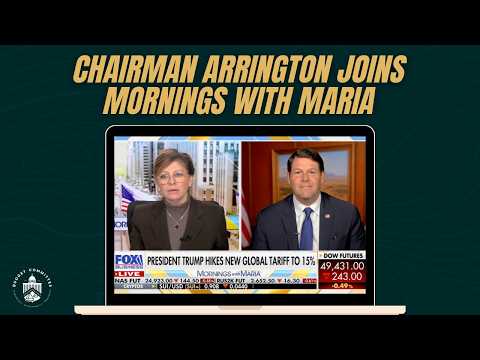
House Budget Chairman Jody Arrington urges Republicans to use reconciliation to lock in trade and entitlement changes
Loading...
Summary
Rep. Jody Arrington said Republicans should use the reconciliation process to advance trade, health-care and entitlement reforms, arguing it is the "most consequential legislative tool" to protect economic and national security interests and to codify recent trade deals.
Rep. Jody Arrington, chairman of the House Budget Committee, said Republicans should use the reconciliation process to pursue a package that both advances economic priorities and addresses national-security risks posed by foreign dependence on key supplies.
"Why wouldn't we use the most consequential legislative tool we have," Arrington said, arguing reconciliation would let Republicans "build on" prior legislation that he described as producing economic growth, higher wages and lower energy costs. He said a reconciliation bill should include "more controls to prevent the waste and fraud" he attributes to means-tested welfare programs and other entitlements.
Arrington framed parts of the package in trade and security terms: "Let's come alongside the president and let's codify Trump's America First trade deals that have opened up access to new markets, leveled the playing field, and have, addressed what I think is a major national security, threat in terms of dependence on other countries for important materials and products, whether it's wafer manufacturing or drugs," he said.
The chairman also discussed timing constraints. The host noted that a referenced provision (stated in the interview as "section 122") would be active for 150 days and that Congress would have to act to sustain related tariffs, and pointed out the timing coincides with an extended congressional recess. Arrington urged a unilateral approach if Democratic cooperation is unlikely: "I don't think we should wait for Democrats to join us," he said, adding Republicans could use statutory trade tools after the 150 days.
Why it matters: Reconciliation is a procedural vehicle that allows certain budget-related measures to pass the Senate with a simple majority, avoiding a 60-vote filibuster. Arrington's remarks signal House Budget Committee interest in bundling trade, spending and entitlement reforms into a package he believes would survive procedural challenges and align with presidential trade policy.
The interview did not identify specific statutory language for many of the proposals, nor did it list concrete bill text or a timeline for introduction. Arrington's comments reflect priorities; next steps would require formal drafting and votes in both chambers.