Carlton County jail nurse outlines pregnancy screening, MAT and new locked women’s treatment program
Loading...
Summary
Carlton County correctional‑health nurse Holly Campo described intake screenings, statutorily required pregnancy testing, ongoing medication‑assisted treatment (MAT) practices and a 60‑day locked Justice‑Involved Female (JIF) treatment program expected to begin in March.
Holly Campo, a correctional‑health nurse who formerly worked in Carlton County Public Health and now is employed by the sheriff’s office, told the St. Louis County perinatal coordination team that Carlton County’s jail and neighboring Lake County jails are increasing services for pregnant and justice‑involved women.
Campo said the county must "offer pregnancy testing to every woman under the age of 50," citing Minnesota statutes addressing anti‑shackling and related standards. She said the change helped identify people who had little or no prenatal care after long stays in county jails and supported referrals to community OB and public‑health providers.
Campo described intake procedures that include a roughly 27‑question health screening and an eight‑question mental‑health instrument used to identify needs for follow‑up. "We ask questions about like pre screening questions about tuberculosis, dental, pregnancy, seizures," she said, and staff follow up on positive screens.
On treatment for substance use, Campo said Carlton County provides the three commonly used medications: methadone, buprenorphine (Suboxone/Subutex) and naltrexone. She said injections such as Vivitrol are rarely used because of cost, and that the county continues prescriptions brought in by people who arrive already on treatment. The jail has begun telehealth inductions to avoid long transports to Duluth: "We recently were able to start doing some inductions via telehealth," she said.
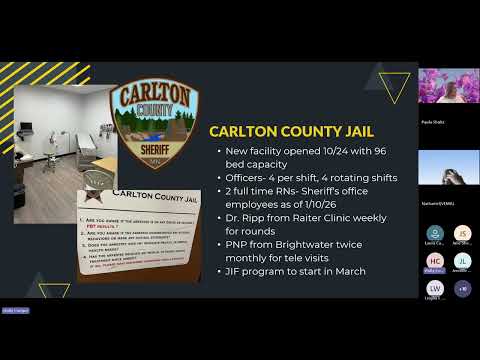
Campo also described a new, 60‑day locked Justice‑Involved Female (JIF) treatment program scheduled to begin in March. Two people were already slated to start and staff were finalizing referral pathways; Campo said program staff are conducting outreach to probation, public defenders and other partners to accept women from across the region.
She outlined operational realities for small jails: Lake County’s facility is a 17‑bed jail with two corrections officers on duty, while Carlton County opened a new 96‑bed facility in October 2024 and has shifted nurses from public‑health employment to sheriff’s‑office staff. Campo said staffing shortages remain a constraint.
During questions, a participant asked about privacy and HIPAA during jail clinical encounters. Campo said officers’ proximity is prioritized for safety and can limit private listening to some conversations. When asked how many women in custody were pregnant, she estimated about six females in custody with one confirmed pregnancy at the time of the meeting.
Next steps: the JIF program was expected to begin enrollment in March; Campo offered to connect attendees with Amber Jacobson, the program lead, for further coordination and referrals.