City Council committee hears testimony on bills to protect safe access to schools and houses of worship
Loading...
Summary
Religious leaders, civil-rights groups and council members testified in support of a New York City Council package that would require NYPD transparency on buffer zones and other measures to protect access to schools and places of worship amid rising hate incidents.
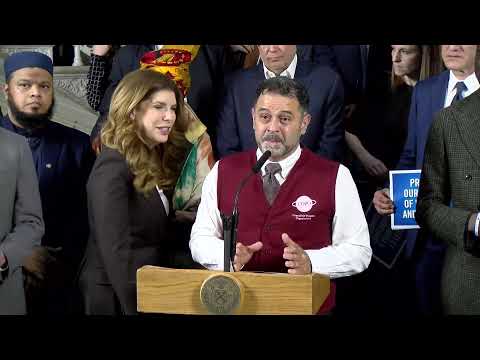
New York — Religious leaders, advocacy groups and council members on Wednesday urged the New York City Council’s Committee to Combat Hate to pass a package of bills that would require the NYPD to publish a plan for protecting safe access to schools and houses of worship and establish criteria for buffer zones when protests risk intimidation.
The committee’s chair, Council member Yousef Salaam, said the city has seen a string of disturbing incidents — spray-painted anti-religious graffiti, attacks targeting Muslim women wearing hijabs and antisemitic vandalism — and that the bills combine prevention, reporting and security measures. "We gather here today in response to the deeply troubling hate crimes and acts of bias that continue to plague our city," Salaam said.
The legislation would direct the NYPD to develop and publish guidance identifying when temporary buffer zones near entrances and exits are necessary to protect safe entry and exit, while aiming to preserve constitutionally protected protest activity. Sponsors and witnesses framed the proposal as a narrow measure to prevent intimidation rather than to curtail lawful speech.
Council member Lynn Shulman, vice chair of the Jewish caucus and a cosponsor, said the bills "take a comprehensive approach" that includes strengthening hate-crime reporting, creating a bias-reporting hotline and improving emergency planning. "That right is fundamental, but protest cannot become harassment and speech cannot become intimidation that interferes with someone's ability to safely worship," she said.
Representatives from community organizations highlighted the scale of recent incidents. Scott Richmond, ADL regional director, said ADL tracked nearly 1,000 antisemitic incidents in New York City in 2024 and 157 attacks targeting synagogues and Jewish institutions locally; he urged the council to pass the buffer-zone measure without delay. "This bill carefully balances free speech with the fundamental right to worship safely," Richmond said.
Speakers from multiple faiths — including imams, Catholic and Protestant leaders and Jewish communal officials — told the committee that faith communities and schools have felt heightened fear and that local families have been shaken by demonstrations and vandalism. Mark Trager of the Jewish Community Relations Council described hearing from a 95‑year‑old Holocaust survivor who said he had feared returning to synagogues, and said the bills seek to prevent intimidation at house-of-worship doors.
Advocates also described related proposals in the package: a bias-reporting hotline to guide victims on where to report incidents, expanded education on online hate and an enhanced database for categorizing hate-crime reports. Council members and witnesses stressed that the bills do not remove protest rights but aim to give clarity about when policing measures are required to ensure safe access to protected sites.
No formal votes or motions occurred during the testimony portion of the hearing. The committee moved into the chambers to begin formal consideration of the bills after the public witnesses concluded.
The committee hearing included multiple speakers of faith and civic groups who backed the package; the council has not yet set dates for final committee votes or full‑council consideration.