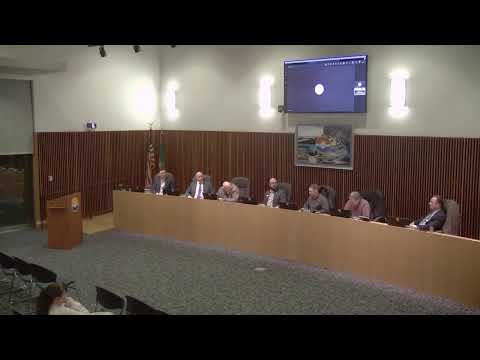
Moses Lake council weighs six‑year financial sustainability plan, rejects local B&O tax as a priority
Loading...
Summary
Councilmembers spent most of the meeting reviewing a six‑year forecast, classifying city programs as core/basic/enhanced, and discussing revenue options. Members signaled opposition to a local business & occupation tax, prioritized economic development, and set community engagement steps including a March town hall and an April decision date.
Moses Lake — City staff presented a six‑year financial sustainability plan and forecasting model that shows a growing budget gap through 2031 and asked council to categorize city programs as core, basic or enhanced and to indicate which revenue options are off the table.
The presentation, led by staff and consultant Madeline, paired program‑level cost assignments with comparative data from nearby cities to show the city portion of property tax, assessed value per capita and taxable sales per capita. Staff said the plan will be used to set reserve goals and guide budget choices, noting the city has “a little over 1,000,000 in bank capacity” for property tax but that long‑term solutions will require either revenue increases or service reductions. Council agreed staff should return with a finer breakdown of the miscellaneous general‑government line and other line‑item details at a future meeting.
Why it matters: staff framed the work as a proactive effort to avoid an eroding fund balance and to clarify what services are legally required versus discretionary. The council spent considerable time debating policy trade‑offs — whether to emphasize organic assessed‑value growth and economic development or pursue a menu of new local taxes.
Council members repeatedly voiced a preference for growth over new business taxes. “Economic development is the best way to solve your budget problems,” staff told council during the debate, an argument several members endorsed while noting it can take years to yield results. Multiple councilmembers said they opposed a local B&O (business & occupation) tax as inconsistent with the city’s economic strategy.
Staff outlined several near‑term options that remain under consideration: using banked property‑tax capacity (statutorily available levy capacity), voter‑approved levy lid lifts, formation of a metropolitan park district where appropriate, targeted council‑adopted sales tax options for cultural or public‑safety purposes, and modest utility tax adjustments. Staff gave rough revenue estimates and household impacts for those options and asked council to identify nonstarters; several members flagged a local B&O tax as a nonstarter.
Next steps: staff will run the council’s direction through the financial model at the April 14 meeting, complete a month of community engagement in March (including an online budget simulation and a mailed notice to city households), and return with updated recommendations for action and possible budget adoption later in April. A public town hall on the financial plan is scheduled for March 16.