
Committee hears Bailey Group pharmacy analysis showing potential multi-million-dollar savings for city health plan
Get AI-powered insights, summaries, and transcripts
Subscribe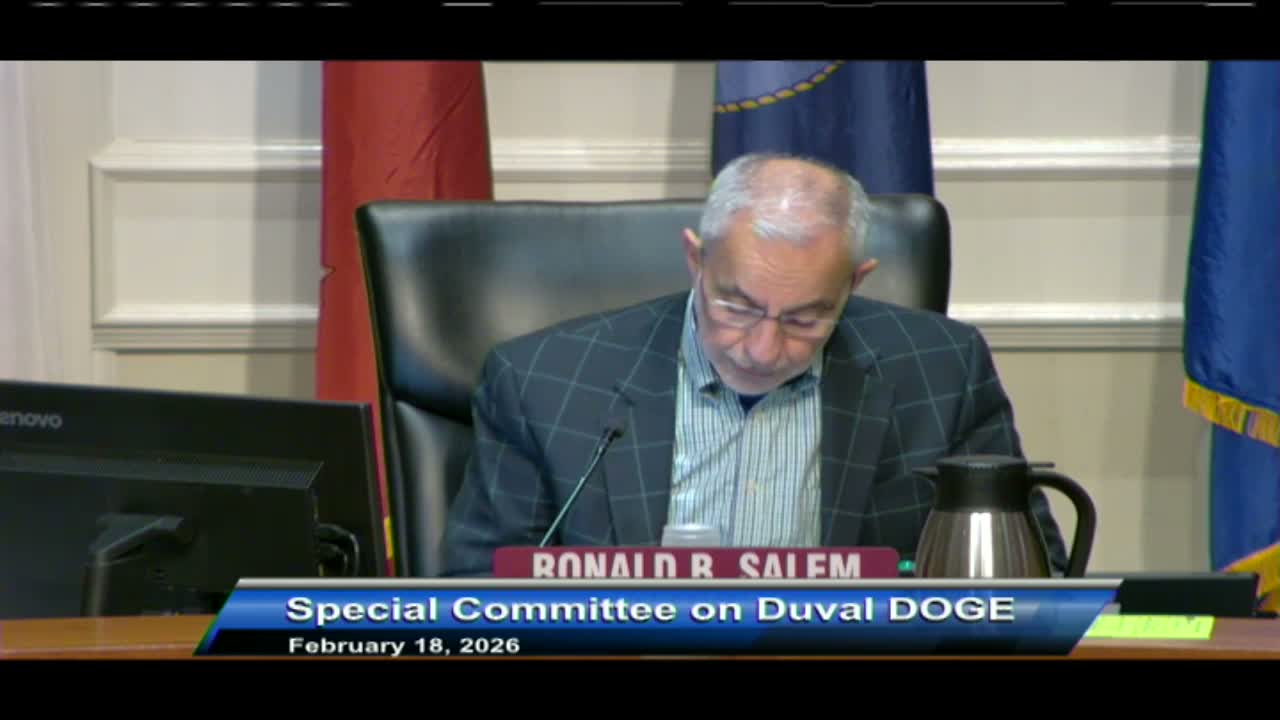
Summary
City committee heard a Bailey Group presentation showing the city—ould reduce pharmacy costs by several million dollars annually by changing pharmacy benefit management arrangements, increasing rebates and adding a specialty coupon program; presenters emphasized changes would not increase employee copays.
A Jacksonville special committee on Duval Doge on Feb. 18 heard a detailed pharmacy analysis from the Bailey Group that projects multi-million-dollar annual savings for the city—mployee health plan without changing member copays. Chair Ron Salem facilitated the presentation and said the committee will pursue next steps with city administration.
The consultant, Mark Bailey, told the committee the plan—overed $22,800,000 in gross pharmacy costs over the reviewed period and that gross cost per member per month was $314.83. Bailey said specialty drugs accounted for about $11,900,000 of that total and that shifting pharmacy benefit managers (PBMs) or changing contract terms could materially increase rebates and lower net cost.
Bailey presented comparative scenarios for several PBMs and contract structures. He said current rebates were about $6,400,000 on the plan and that an Express Scripts scenario would raise rebates in the consultant nalysis to roughly $10,700,000, producing contract-to-contract savings in the low millions. He also described an optional specialty program (referred to as SaveOn/Savant in the presentation) that uses manufacturer coupons and patient-assistance programs to reduce member out-of-pocket cost to zero for eligible specialty drugs while lowering plan expense; Bailey estimated that program could yield roughly $700,000 to $800,000 in guaranteed savings for the plan.
Committee members pressed on member impacts and implementation. Council member Will Lane asked whether GLP-1 drugs for weight loss only were currently covered; Bailey said the numbers suggest the plan likely does not cover GLP-1s for weight-loss-only indications and stressed the need for clinical documentation and prior authorization when drugs are covered for diabetes diagnoses.
On member cost-sharing, Bailey and Chair Salem repeatedly emphasized the projected savings would not be achieved by increasing employee co-pays. "These savings are not on the back of the employees or their dependents," Chair Ron Salem said, noting co-pays in the consultant—xamples remain the same.
Bailey advised the committee to gather updated claims data through year-end, confirm how the pass-through administrative fee and any incumbent credits are being applied, and consider an RFP or renegotiation. He recommended a runway of about 90 days for implementation and said some public-sector groups have completed midyear PBM transitions when savings warranted it.
Next steps recorded in the meeting included facilitating a meeting between the Bailey Group, committee leadership and city administration to reconcile pass-through fee calculations and claims data and to determine whether to pursue an RFP or other procurement route. Chair Salem said he would contact the administration and help arrange the follow-up meeting.
The committee did not take a formal vote on a PBM change at the Feb. 18 session; members asked for further data and directed staff and consultants to continue analysis and coordination with procurement and administration.