Oregon Supreme Court’s State v. Roberts establishes 60/90‑day counsel deadlines; committee hears narrow carve‑outs
Loading...
Summary
Legislative Counsel told the Public Safety Subcommittee the Oregon Supreme Court found a state‑constitutional right to counsel violation in State v. Roberts and set bright‑line timelines — 60 days for misdemeanors, 90 for felonies — ordinarily requiring dismissal without prejudice, while leaving rare "exceptionally good cause" exceptions to judges.
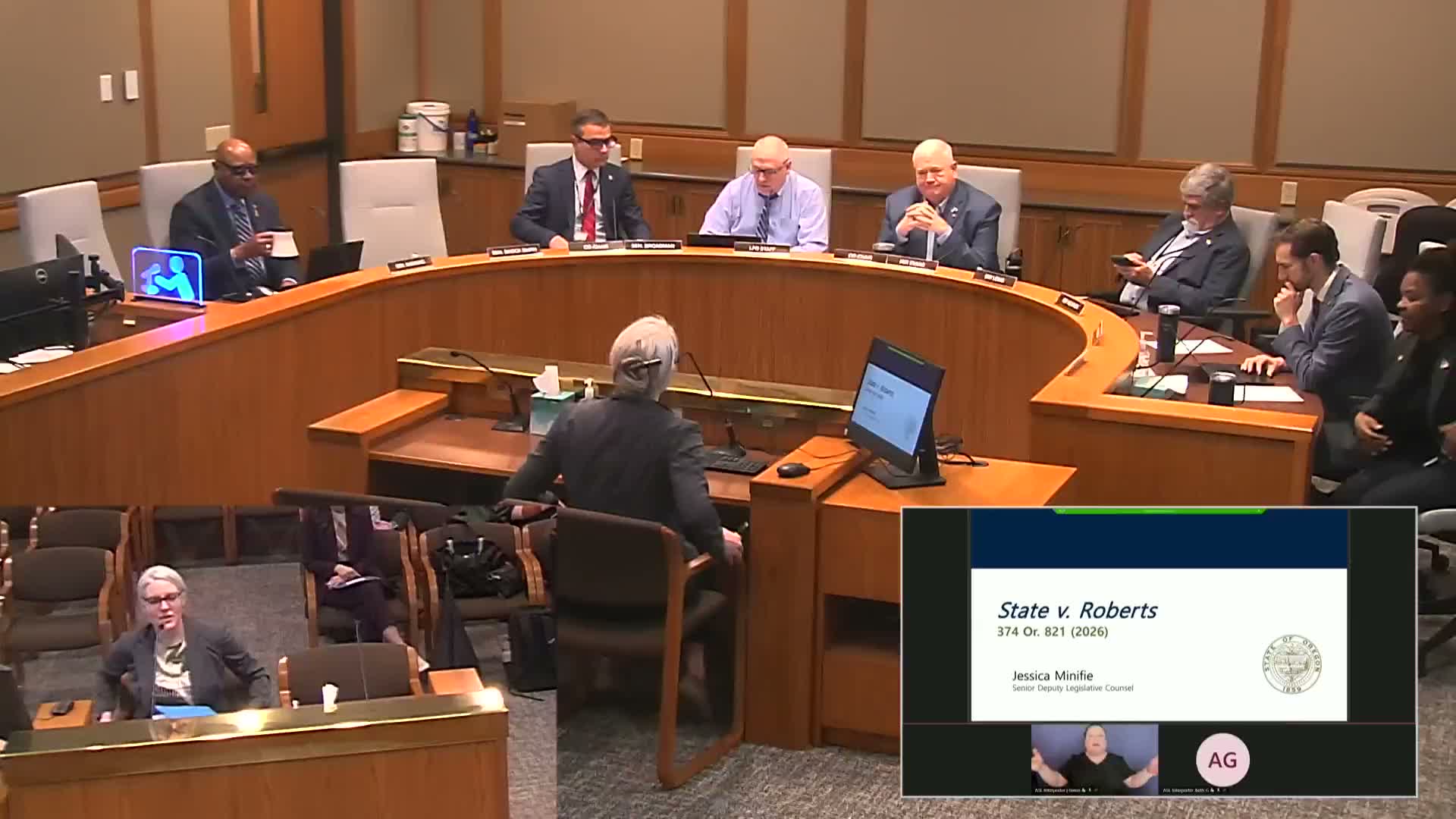
The Public Safety Subcommittee heard a concise legal overview on Feb. 19 of State v. Roberts and the remedy the Oregon Supreme Court prescribed for cases where eligible defendants lack counsel.
"The conclusion was that Mr. Roberts' right to counsel was violated," Jessica Menifee, an attorney with Legislative Counsel, told the committee, summarizing the court's determination and its focus on Oregon's state constitutional protections rather than the federal Sixth Amendment. Menifee said the court adopted a bright‑line remedy: dismissal without prejudice when an eligible defendant goes unrepresented for more than 60 consecutive days in a misdemeanor case or 90 consecutive days in a felony case.
Menifee explained the court’s rationale centered on three harms an unrepresented defendant can suffer — restraints on liberty, stalled case advancement (no investigation or evidence gathering), and pressure to waive counsel as delay accumulates. She emphasized that the decision treats the 60/90‑day measures as consecutive days and that the opinion left open limited circumstances in which dismissal might be avoided.
On the scope of exceptions, Menifee said the opinion does not define "exceptionally good cause" and that courts will decide such claims case‑by‑case. "It does seem like that's a high bar," she said, adding that a new arrest that brings a defendant into custody could plausibly qualify as such a circumstance.
The committee pressed for clarity about custody status and whether time spent while a defendant is subject to a bench warrant counts toward the consecutive‑day totals. Menifee said the opinion does not draw a bright line on that point; her read was that warrant status may effectively pause or restart the timeline until the defendant returns to court, but the court left room for judicial judgment.
Why it matters: the court’s bright‑line approach provides clearer timelines than earlier federal precedents, but it creates an immediate operational imperative: courts, prosecutors and public defenders must identify prospective Roberts cases and prioritize appointment of counsel to avoid dismissal that could lead to refiling burdens, victim impacts and, in some instances, an effective bar to reprosecution if statutes of limitation have run.
What comes next: Menifee and committee members agreed that the standard announced in State v. Roberts will require continued judicial review, localized case‑by‑case assessments and close coordination among OJD, district attorneys and the Public Defense Commission as they apply the new deadlines.