
Assembly committee hears calls for more training, funding and interoperable communications to cut mass-shooting harms
Get AI-powered insights, summaries, and transcripts
Subscribe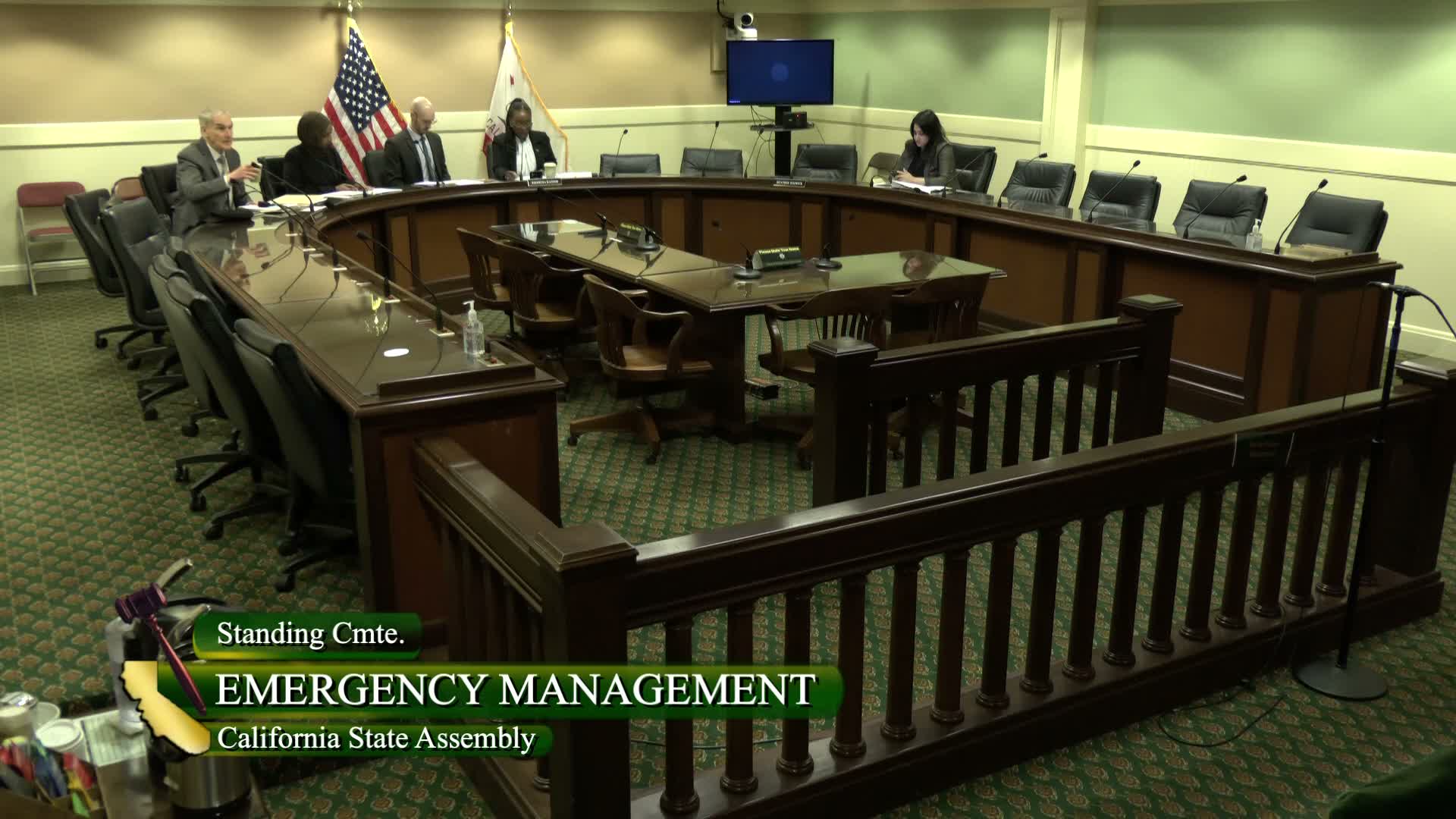
Summary
At a California State Assembly Emergency Management Committee hearing, law-enforcement and public-safety leaders urged more funding, standardized training and improved interoperable communications to reduce deaths and speed response after active and mass shootings. Witnesses highlighted gaps in drills, information sharing and campus policing standards.
The California State Assembly's Emergency Management Committee convened a hearing on active and mass-shooter incidents that brought together law-enforcement leaders, campus public-safety officials and state agencies to review prevention and response gaps and recommend steps to reduce deaths and injuries.
Chief Jason Salazar, president of the California Police Chiefs Association, told the committee that response to active-shooter incidents follows three priorities: stop the killing, stop the dying and stabilize the scene. "When an active shooter incident begins, the priorities for first responders are straightforward," Salazar said, adding that interoperable communications, rapid medical care and joint training are essential to improve outcomes. He cited FBI figures showing 223 active-shooter incidents nationally from 2020 to 2024 and urged investment to finish the state's transition to NextGen 911 so dispatchers can share video and texts with responders.
Don O'Keefe, chief of the law-enforcement branch at the Governor's Office of Emergency Services (Cal OES), described statewide prevention efforts and grant programs. Cal OES's "Reduce the Risk" initiative promotes extreme-risk protection orders (GVROs/ERPOs) and outreach; O'Keefe said GVROs have helped prevent dozens of threatened mass-violence incidents. He also summarized nonprofit-security grant funding: in fiscal year 2025 the state program had $76,000,000 available and the federal nonprofit security grant apportioned to California totaled about $26,200,000; Cal OES reported receiving roughly 1,200 applications requesting more than $226,000,000.
Sheriff Patrick Withrow of San Joaquin County described operational challenges his office faced after the Nov. 29 Stockton shooting, which he said left about 17 people injured and four dead, and included victims under age 14. Withrow said delays in locating the scene and widespread misinformation complicated the initial response. He also criticized some recent criminal-justice reforms, arguing they limit early intervention opportunities: "We're starting to lose a key part of early intervention and prevention, with many of the well-intentioned laws that are being passed in our state that are starting to tie the hand of law enforcement officials," Withrow said.
Panelists repeatedly called for multidisciplinary drills that include police, fire, emergency medical services and hospitals, though they said those exercises are costly and unevenly distributed by jurisdiction. David Carlisle, assistant chief at the University of Southern California Department of Public Safety, described realistic campus drills and the importance of mass-notification systems and threat-assessment teams. Carrie Holler of POST (the Commission on Peace Officer Standards and Training) told the committee that POST now requires a minimum of 16 hours of standardized active-shooter training in the basic academy for recruits, effective April 1, and that ongoing training for incumbent officers varies by agency.
Medical response was emphasized as well. Dr. Hernando Garzon, chief medical officer at the State EMS Authority (EMSA), outlined EMSA's responsibility for medical components of terrorism and active-shooter response and said local EMS integration varies widely; continuing-education standards for EMS personnel on this topic remain limited.
Committee members repeatedly raised the tension between robust training and the risk of traumatizing students during drills. Kimberly Rosenberger of the Department of Education noted that federal Clery Act requirements apply to higher education and that K-12 plans must avoid simulated gunfire or theatrical props and provide opt-outs and post-drill mental-health resources.
The hearing closed with repeated calls for funding to support equipment (including protective gear for firefighters and EMS), technology such as camera systems, and sustained multidisciplinary exercises. Cal OES, POST, EMSA and the Department of Education each said they would continue technical assistance and that additional coordination or auditing of school safety plans might be useful. The committee did not vote on legislation at the hearing; staff said they will review notes and may return with proposals.