Get AI Briefings, Transcripts & Alerts on Local & National Government Meetings — Forever.
California assembly panel reviews EDD Next modernization and whether EDD is ready for the next recession
Loading...
Summary
The Legislative Analyst’s Office and Employment Development Department told Assembly Budget Subcommittee No. 5 that technology and process improvements have materially improved EDD’s capacity since 2020, but legacy COBOL systems and recent scope changes in the EDD Next project leave identifiable risks ahead of a future downturn.
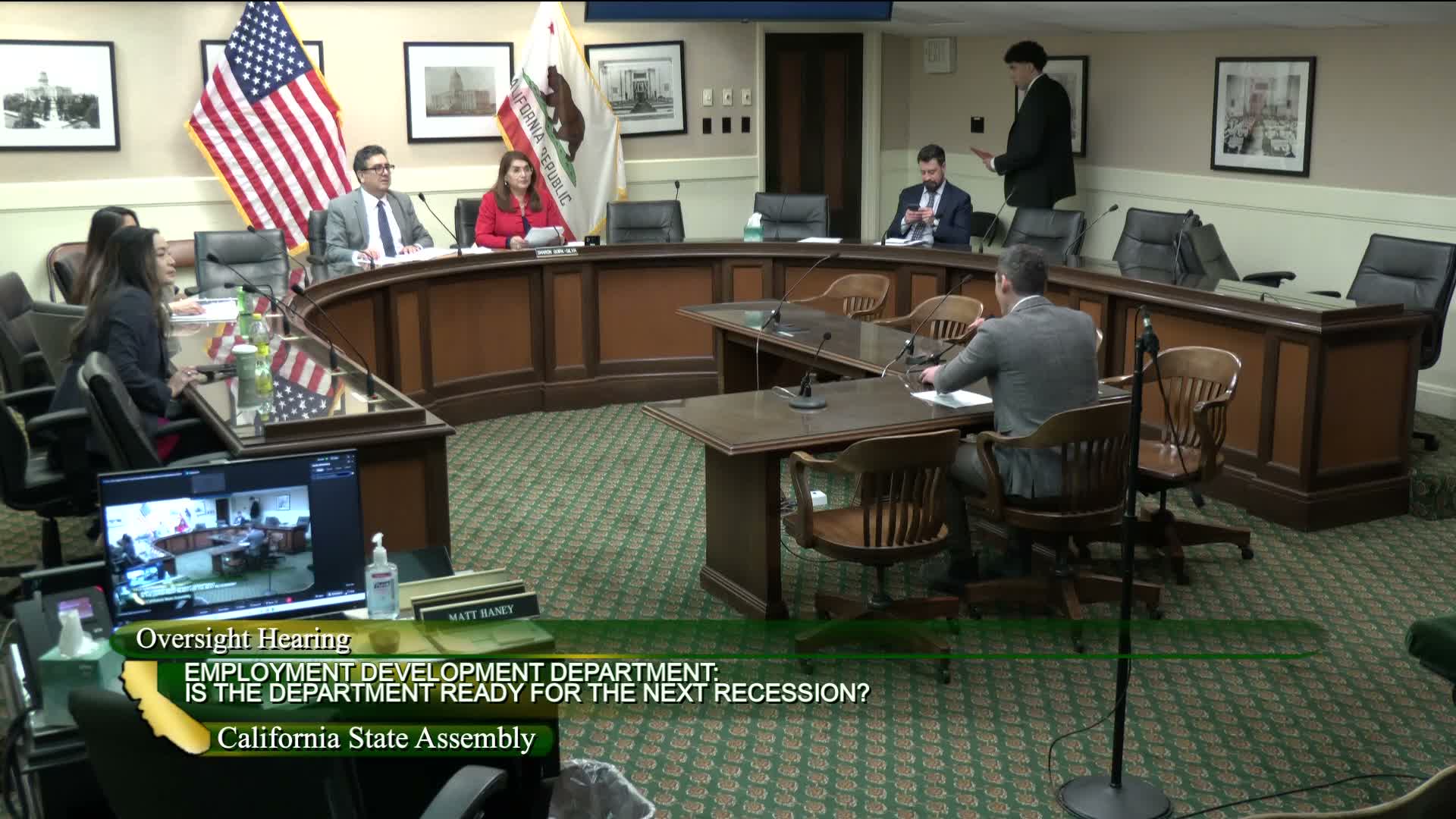
The California State Assembly Budget Subcommittee No. 5 on State Administration heard Tuesday that the Employment Development Department (EDD) has made measurable customer-service and technology improvements, but lingering legacy systems and recent project changes pose risks if another recession forces a sudden surge in claims.
At an informational hearing, Charles Alamo of the Legislative Analyst’s Office (LAO) outlined the state’s three largest worker benefit programs—unemployment insurance (UI), disability insurance (DI) and paid family leave (PFL)—and traced EDD’s modernization efforts from early attempts in 2003 through the current EDD Next program. "The state is in a much better position to be prepared for heightened workload during a recession," Alamo told the committee, while warning that the most complex elements of the modernization, including the integrated claims management system (ICMS), are only just beginning.
Amy Faulkner, EDD’s chief deputy director, told the panel the department is "prepared for any downturn" and has a 100-page recession plan prepared for execution. Faulkner highlighted customer-facing upgrades: a shared customer portal, virtual-assistant chat, expanded live-chat support in the top eight languages, a redesigned call-center platform for DI and PFL, and phased rollout of improved identity verification. She said recent improvements have raised on-time processing rates: EDD reported about 83% of PFL claims and roughly 84%–85% of UI and DI claims are processed within the department's stated timeliness goals.
Why modernization still matters: LAO and EDD witnesses emphasized that key backend infrastructure still runs on COBOL-era mainframes and that many newer features rely on fragile custom connections. "If some of those functionalities don't work during heightened workload," Alamo said, "program deliverables could be compromised during a downturn." EDD confirmed the state initiated the ICMS vendor contract this month; ICMS is the most complicated phase because it replaces the COBOL-backed database core that underlies all claims programs.
Scope sequencing and budget: The administration and EDD said they are proceeding with a phased approach that implements DI and PFL functionality first and contemplates integrating UI later. EDD officials framed this as an "agile" choice aimed at reducing vendor and implementation risk and cited market feedback that DI/PFL are easier initial targets because their customer bases are smaller. The current budget request includes about $146 million for EDD Next in the upcoming fiscal year; LAO noted total appropriations to date linked to EDD Next are roughly $931 million, while cautioning that adding up every modernization dollar since 2003 would require further analysis.
Pandemic fraud and federal programs: LAO stressed that much pandemic-era fraud was concentrated in temporary federal pandemic programs that lacked the state's usual employer-notification and wage-verification safeguards. "The fraudulent payments were made by the federal program," Alamo said; "the UI loan that we are repaying the federal government was not largely attributable to fraud." EDD and LAO officials said improvements such as real-time identity verification, data matches, document-management systems and third-party identity services have strengthened fraud detection.
Oversight and next steps: LAO recommended heightened legislative oversight, including more frequent reports and review touchpoints tied to significant procurement decisions. EDD said the ICMS procurement will include independent oversight and regular reporting. The subcommittee scheduled follow-up hearings and asked both LAO and EDD for more granular cost accounting, paper-vs.-online claim breakdowns, and stress-test outcomes.
What’s next: The hearing produced follow-up requests for detailed vendor and contract information, an aggregated modernization-cost accounting dating to 2003, and clarifications about the fiscal effect of phasing UI later. The subcommittee also set a March 10 session to continue discussion of EDD Next and paid family leave.