Appropriations committee advances diverse package of bills on school safety, kinship care, workforce and infrastructure
Loading...
Summary
The Senate appropriations committee moved a wide set of bills to the floor, including measures on school AED reporting, interoperability for school safety, kinship foster stipends, reentry grants, veteran park passes, an allied health workforce program, and appropriations for ports and research centers. Outcomes and vote tallies for each bill are summarized below.
The Senate Committee on Appropriations — Transportation & Technology advanced a broad slate of legislation on Feb. 20, 2026, moving items that ranged from school-safety data collection to workforce development and infrastructure appropriations.
Key votes at a glance
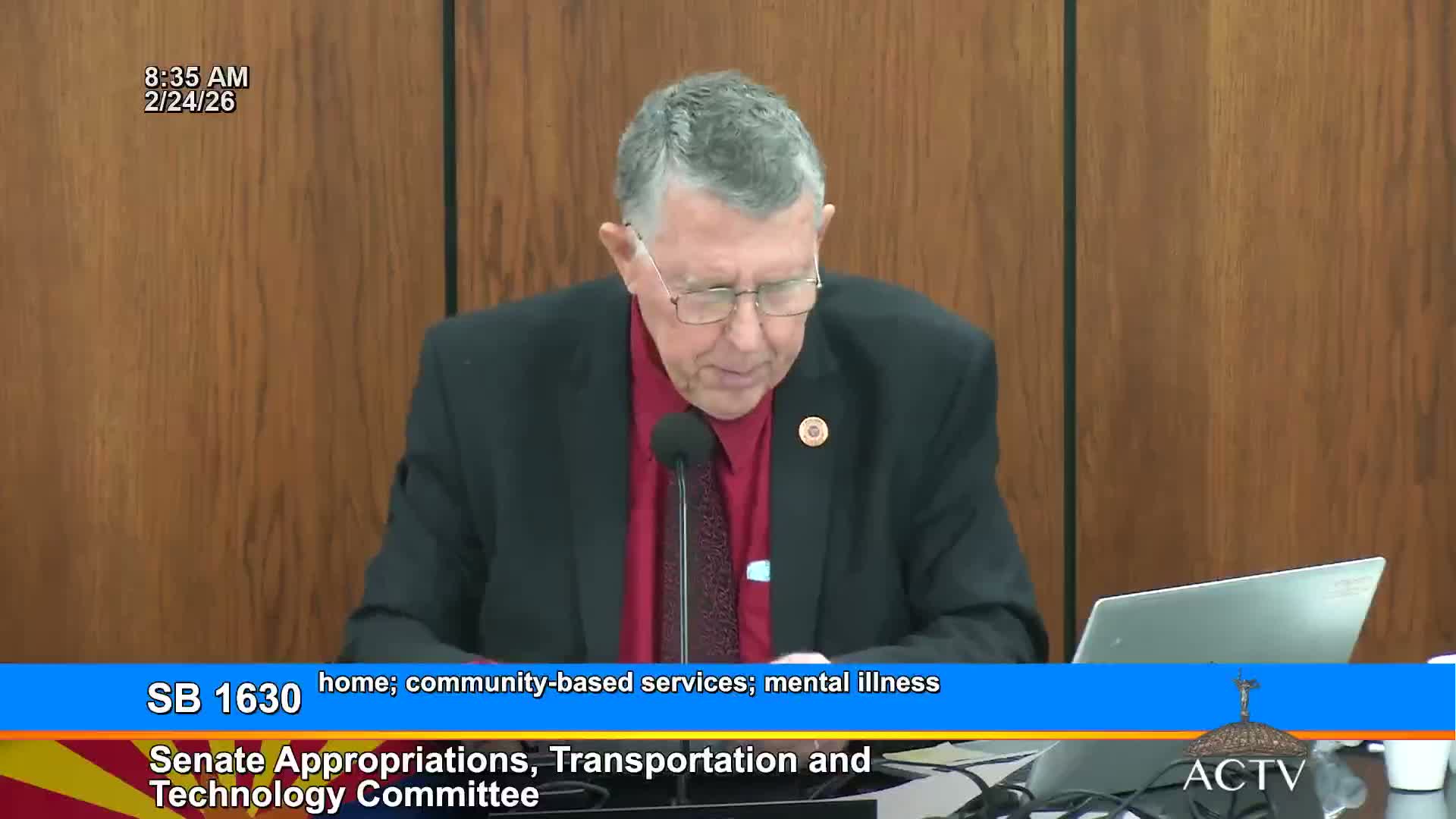
- SB1630 (HCBS for SMI) — Adopted Angus amendment; due-pass recommendation 10–0. Supporters argued the Medicaid waiver pilot would permit long-term community care for a capped SMI population; AHCCCS emphasized the need for CMS approval and cited a total-fund estimate of roughly $27.7 million including $5.83M general fund.
- SB1131 (school cardiac emergency reporting) — Warner amendment adopted; due-pass recommendation 9–1. The amendment replaced a mandate with a one-time reporting requirement to ADE and preserved a $1M appropriation prioritized to rural schools for AED purchase and maintenance.
- SB1582 (school safety interoperability) — Farnsworth amendment adopted; due-pass recommendation 6–4. County sheriffs and school officials said interoperability systems have provided useful drill and limited real-world benefits for information-sharing between schools and dispatch centers.
- SB1504 (public safety pensions) — Kavanaugh amendment adopted but the bill failed in committee, 3–7. Testimony was extensive; employers warned of large prefunding liabilities while unions and public-safety groups argued for changes to recruit and retain staff.
- SB1602 (kinship foster monthly stipend phase-in) — Amendment adopted; due-pass recommendation 9–0 (one not voting earlier). Sponsor framed the bill as a child-safety measure that keeps children with family and reduces group-home placements.
- SB1317 (reentry grants to counties) — Due-pass recommendation 7–2–1 (roll call). The bill would appropriate $20M from opioid-settlement monies to support reentry programs and a shared statewide database.
- SB1673 (victim notification) — Amendment adopted; due-pass recommendation 8–1–1. Testimony from chiefs and sheriffs emphasized the system’s role in notifying crime victims about case status and release information.
- SB1718 (Public Education Foundation specialty plate) — Due-pass recommendation 10–0. Creates a special plate fund to support nonprofit education programs if an implementation-fee threshold is met.
- SB16-72 (antipsychotic access for SMI) — Sponsor amendment adopted; due-pass recommendation 9–1. The committee advanced language that would limit prior authorization and codify a two-step administrative requirement for SMI-designated AHCCCS members; debate focused on fiscal-note assumptions and rebate treatment.
- SB1461 (allied health workforce development) — Due-pass recommendation 8–0–2. The bill (reduced appropriation) funds a proven tuition-free allied-health pipeline model, with wraparound student supports and employer partnerships to sustain the program.
- SB1267 (minimum wage exemption for certain supported workplaces) — Strike-everything amendment adopted and bill given due pass recommendation 5–4–1. The measure drew strong testimony on both sides: proponents said exemptions preserve sheltered employment opportunities; opponents called the change discriminatory and urged alternatives to undercutting wage standards.
- SB1272 (Douglas port of entry state match) — Amendment lowered the appropriation; committee gave due pass recommendation 6–3–1. Mayor of Douglas urged the committee to close funding gaps to secure a multi‑hundred‑million-dollar federal GSA investment contingent on local project readiness.
- Additional appropriations and program bills advanced included a statewide incident management platform for fire response (SB1580, due pass 6–3–1), DOC recruitment and retention support (SB1584, due pass 6–2–2), a Yuma Center of Excellence and experiment-station investments (SB1761, due pass 7–1–2), and numerous smaller items for parks, trails and advanced-air-mobility coordination.
Members flagged a range of follow-ups: clarifying fiscal-note assumptions (particularly for pharmacy and pension measures), confirming rebate and Medicaid accounting, and further discussions with stakeholders before floor votes. The committee paused at the end of the hearing with numerous items to carry to the Senate floor in the coming days.