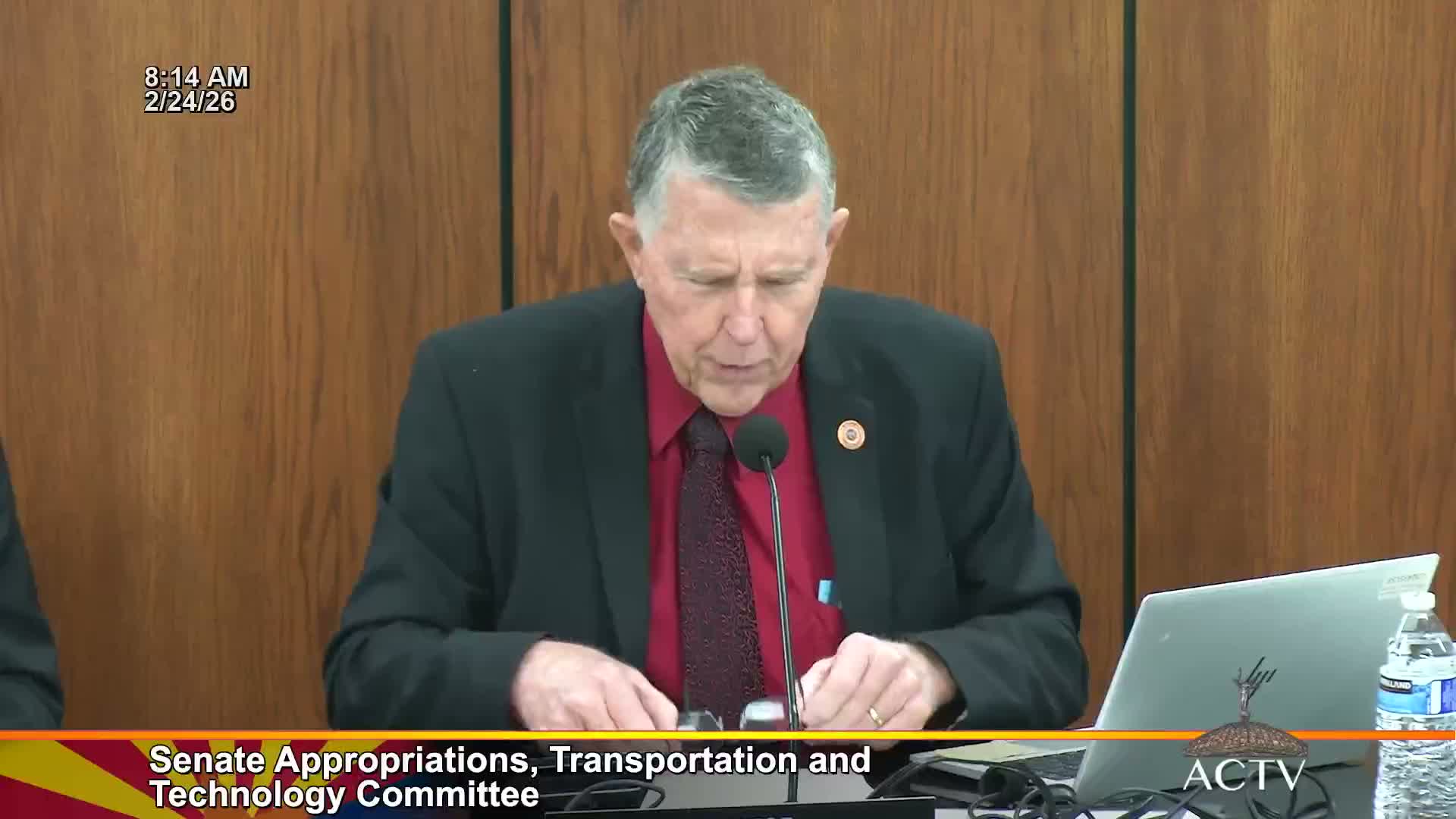
Senate committee backs pilot Medicaid HCBS program for people with serious mental illness
Loading...
Summary
The Senate appropriations committee gave a due-pass recommendation to SB1630 as amended, a plan that directs AHCCCS to seek a federal waiver to create a capped Medicaid-funded home- and community-based services program for adults with serious mental illness. Supporters said the pilot could shift costly hospitalizations to community care; AHCCCS staff and fiscal notes highlighted federal matching and implementation costs.
Senate Bill 16-30, as amended, received a due-pass recommendation from the Senate Committee on Appropriations — Transportation & Technology after supporters argued it would provide an accountable, Medicaid-funded long-term community care option for the most severely mentally ill Arizonans.
Sponsor Senator Angus said the narrowly targeted program is intended for people with severe, disabling brain disorders such as schizophrenia and mood disorders with psychotic features and is capped to limit financial risk. "This bill creates accountability," Angus said, noting the program starts with a 250-person cap and can expand only if the program demonstrates cost savings or neutral fiscal impact. He told colleagues the measure seeks federal approval for an ALTCS-like set of services for the SMI population and estimated an initial funding ask in the fiscal note of about $5 million.
Rachel Strife, a guardian and advocate with Arizona Mad Moms who testified in support, described long hospital stays and repeated crisis care for individual patients and estimated that providing long-term community care to 250 of the sickest patients could save the state roughly $12 million a year. “Kelsey was hospitalized for 182 days in a year,” Strife said, describing the human and fiscal toll.
AHCCCS legislative liaison Damien Carpenter said Access is neutral on the bill and warned that implementation depends on a CMS waiver to draw down federal matching funds. He told committee members a preliminary Access estimate of total fund impact for the program was roughly $27.7 million, including a $5.83 million general-fund share; he said different program components would attract different federal matches (for example, standard FMAP on capitation, higher matches for certain system upgrades).
The committee adopted an Angus amendment that narrowed eligibility and reduced the program’s proposed enrollment cap; it also changed reporting cadence and set legislative oversight for any substantial expansion. After the amendment’s adoption, the committee voted to advance SB1630 with a unanimous voice/roll call vote, 10–0.
What happens next: AHCCCS must pursue federal approval; if CMS approves a waiver and the Legislature provides any necessary funding in the budget process, the agency would implement the new HCBS option under the statutory guardrails and reporting requirements in the bill.