
OHA: 2026 CCO capitation rates rose to 10.6%, agency says rebalance would need $155.1M in general fund
Get AI-powered insights, summaries, and transcripts
Subscribe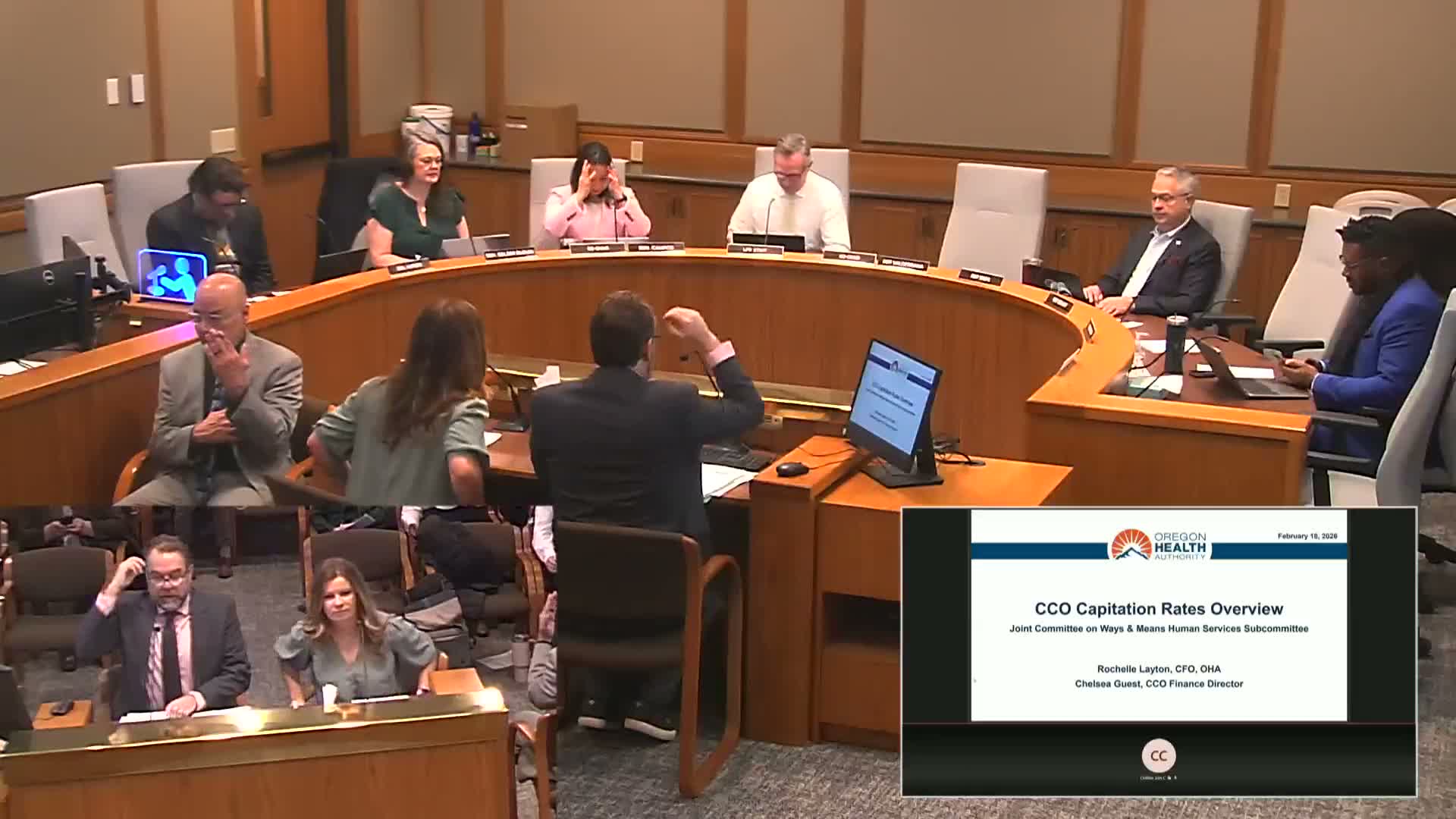
Summary
Oregon Health Authority staff told the Ways and Means Human Services Subcommittee that actuarially sound capitation rates for Coordinated Care Organizations (CCOs) reached 10.6% for 2026 after updated data; OHA proposed offsetting measures and a rebalance request that it estimates would require $155.1 million in general fund support.
Oregon Health Authority officials told the Ways and Means Human Services Subcommittee on Feb. 18 that actuarially sound capitation rates for Coordinated Care Organizations (CCOs) rose to 10.6% for 2026 after OHA incorporated new 2025 data and CCO feedback.
"We have been historically really trying to reach… around a 3.4% year over year growth rate," said Dave Baden, deputy director for policy and programs at the Oregon Health Authority, describing the state target OHA has sought to meet for more than a decade. Chelsea Guest, OHA's CCO finance director, said the agency's initial draft in August put actuarial soundness closer to 6.8% before updated Q2 data from CCOs and other adjustments increased the final 2026 rate to 10.6%: "10.6% is what our 2026 rates ended up with."
OHA told lawmakers that the higher, actuarially determined rates create a budgetary gap. Baden said a 10.6% rate increase would translate into a $155,100,000 general fund need; he described a rebalance package that includes reducing the quality incentive pool for 2025 and 2026 as one proposed offset.
Lawmakers pressed OHA about the relationship between per-enrollee spending and capitation rates. Representative Deal said a national dataset shows all-in per-enrollee spending for Oregon at about $11,051 per year; OHA staff said capitation rates represent the monthly payments to CCOs and that other payments (for example, quality pools, risk settlements and some provider tax mechanisms) sit outside the monthly capitation amount.
Committee members also raised access concerns for specific cohorts. A legislator questioned whether foster-child rate cells account for statutorily required assessments and services and flagged a federal court settlement alleging access problems. Baden said actuaries attempt to account for suppressed utilization in rate cells and offered to provide more detail on how the foster-care cell is constructed.
OHA described a recent network change in Lane County after PacificSource announced it would not renew its Lane County contract. Baden said OHA transitioned members to Trillium Community Health Plan effective Feb. 1 and that Trillium contracted with "over 98% of behavioral health and physical health providers in Lane County," while cautioning that contract status does not always equal access to care.
Baden said changes in caseloads materially affect budget calculations: lower-than-projected caseloads reduced OHA's estimated general fund need by about $170 million, he said, underscoring how enrollment fluctuations can offset or amplify rate-driven budget pressure.
OHA staff told the committee they are working with the legislature and CCOs to move data submission earlier in the cycle to reduce surprises and to improve transparency; Baden noted the legislature has advanced HB 4039, a measure he said aims to increase transparency and timing of rate data. OHA said it will return to the committee with more detail as new information becomes available.
The committee paused the meeting because members needed to caucus and did not take votes on policy changes during this session.