
OHCS presents shelter funding caps, regional cost‑sharing plan and ORDAP eviction‑prevention findings; subcommittee acknowledges reports
Get AI-powered insights, summaries, and transcripts
Subscribe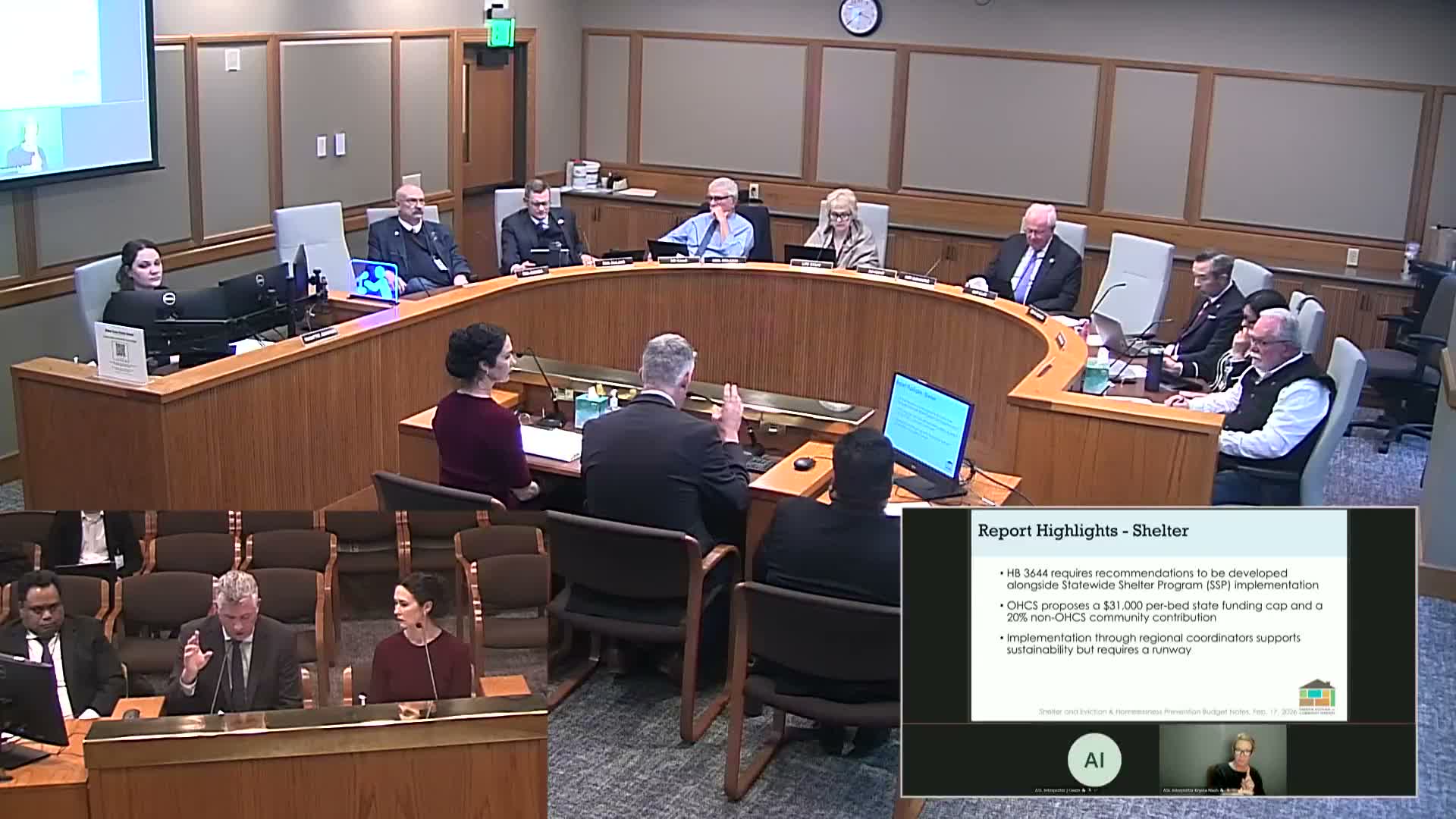
Summary
Oregon Housing and Community Services presented budget‑note findings recommending a $31,000 per‑bed state funding cap, a 20% local contribution expectation, delayed implementation to 2027, and ORDAP eviction‑prevention measures that average under $5,000 per household; the subcommittee acknowledged both reports.
Oregon Housing and Community Services (OHCS) officials told the Joint Ways and Means Subcommittee on Feb. 17 that two budget‑note reports support changes to how the state funds shelter capacity and eviction prevention.
Caleb Yant, OHCS deputy director, said the agency’s work focused on two budget notes: one on creating a sustainable, statewide shelter system and another on eviction prevention methodology. Yant said the agency is managing roughly $210 million for shelter and about $35–46.6 million for eviction prevention across the 2025‑27 budget, acknowledging that legislative funding was allocated across multiple bills.
Liz Weber, director of the housing‑stabilization division at OHCS, described findings from grantee surveys, HMIS data and national best practices. OHCS reported large variation in per‑bed operating costs across shelter types and regions, with some survey responses showing annual per‑bed costs from under $10,000 to six‑figure outliers. Based on the data, OHCS recommended a state funding cap of $31,000 per bed with an exception process for justifiable higher costs (for example, certain youth or family shelters). Weber said the cap is based on housing‑focused shelter averages and noted that the “actual state cost per bed” in the current service level is closer to about $21,000 per year.
OHCS also proposed that regions contribute at least 20% of shelter funding from non‑state sources and recommended delaying any new contribution expectations until 2027 to allow recently selected regional coordinators time to implement local plans. Weber said regional coordinators will be required to report regularly on non‑state contributions and that failure to meet established plans could affect future allocations.
On eviction prevention, OHCS officials summarized the Oregon Eviction Diversion and Prevention program (ORDAP). The agency said ORDAP’s average cost per household in the 2023–25 biennium was under $5,000 and that, with the 2025‑27 contracts, grantees committed to serving roughly 7,255 households. OHCS described efforts taken in year 1 to narrow variation between infrastructure costs and direct client assistance, moving systems toward approximately a 70/30 split favoring direct assistance.
Committee members asked how many shelters are run by nonprofits or local governments and which organizations received funds; OHCS said it will follow up with a grantee list and noted that all recipients must report into the Homeless Management Information System (HMIS) for oversight and outcomes reporting.
DAS Chief Financial Office (Jason Tremblay) and the Legislative Fiscal Office recommended acknowledging receipt of the OHCS reports. A committee member moved the LFO recommendation; the chair asked for objections and, seeing none, the motion carried by unanimous consent with no roll‑call recorded.
Next steps: OHCS will provide follow‑up information requested by committee members, including grantee lists and clarifications on county groupings and funding breakdowns. The agency has been asked to present on expenditures, outcomes and Executive Order 2601 (intensive permanent supportive housing services) in a subsequent session.