State forecast shows $9–$10M shortfall in criminal fine account; agencies urge better data and reporting
Loading...
Summary
DAS and the Judicial Department told the Ways and Means Public Safety Subcommittee the Criminal Fine Account is facing a roughly $9–$10 million revenue decline for the coming biennium; presenters pointed to COVID-era filing drops, restitution priority, remittance orders and data gaps as contributing factors.
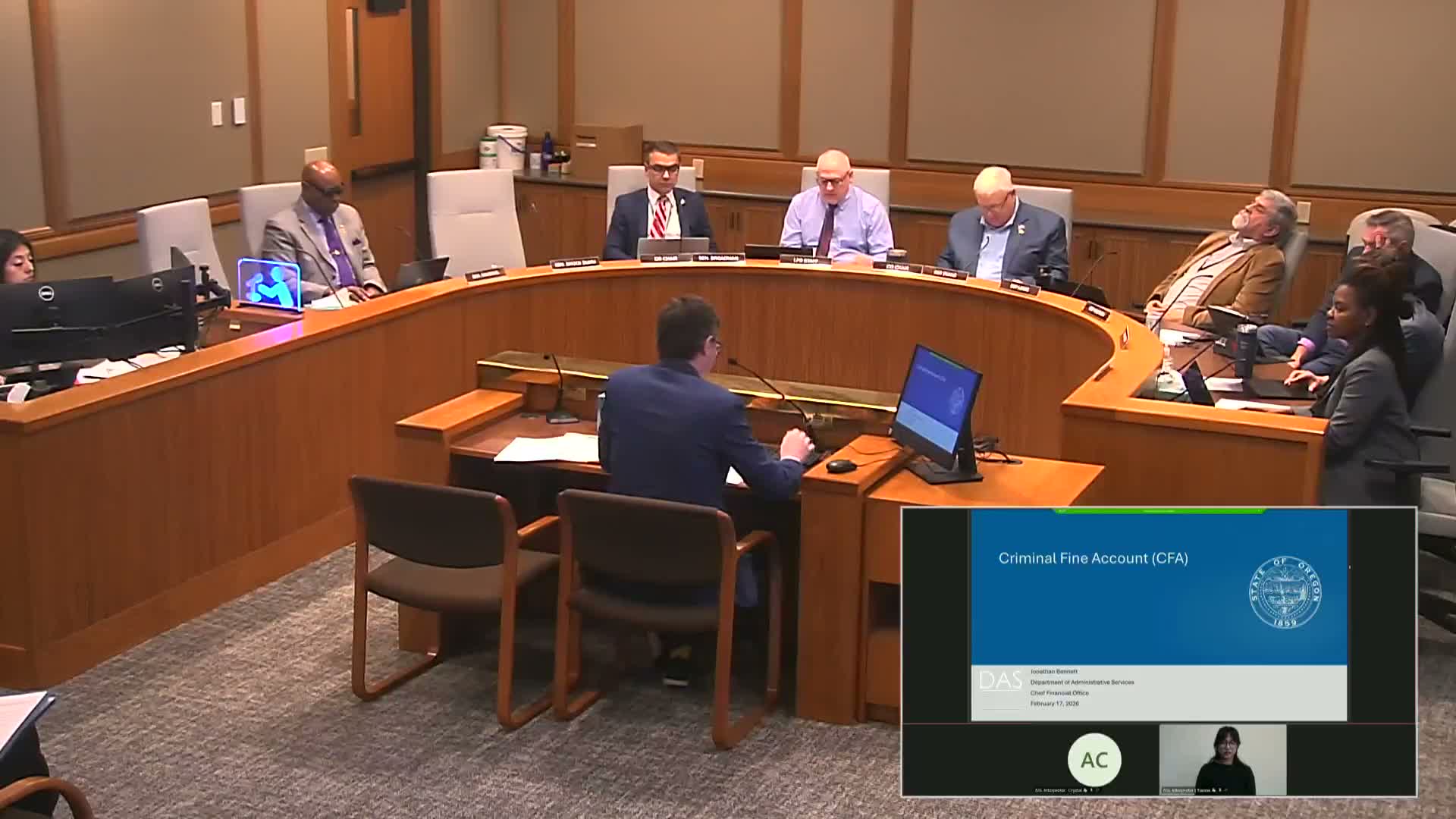
The Department of Administrative Services and the Oregon Judicial Department briefed the Ways and Means Public Safety Subcommittee on Feb. 17 about declining revenue in the Criminal Fine Account (CFA) and the budgeting challenges that creates for programs that rely on it.
Jonathan Bennett of the DAS chief financial office described the CFA’s role and statutory framework (citing ORS 137.300). Bennett said the account typically provides about $100 million for public safety programs, but recent forecasts show a material decline in receipts. In rough terms, DAS estimated CFA receipts are down $9–$10 million from what was assumed in allocations for the 2025–27 biennium.
Bennett walked members through recent history: at the end of the 2023 session the CFA was expected to generate about $118 million but ultimately generated about $97 million. The February 2026 forecast shows a similar tension for 2025–27: expected collections are down roughly $10 million while planned expenditures remain near prior allocations, creating a budget gap that the Legislature will need to address if the allocations are to match receipts.
Nancy Cozine and Jessica Rozier (OJD) explained drivers and data limitations: violation filings (the largest CFA component) fell during COVID due to moratoria and behavior changes and have rebounded; restitution priority (House Bill 4075) shifts receipts toward restitution collection before fines/fees; governor remittance orders in 2022–23 removed about $8 million in unpaid traffic fines; and DOR receives lump-sum transfers without case-type details, making granular forecasting difficult.
OJD recommended expanding financial audits and including supporting caseload information with CFA transfers to improve transparency and forecasting. Committee members asked for additional revenue breakdowns by case type and whether traffic citation changes have affected receipts; DAS offered to follow up with more detailed analysis.