Get Full Government Meeting Transcripts, Videos, & Alerts Forever!
Get email alerts on the Set Asides And Acp topic
No spam. Unsubscribe anytime.
Courts warn of ‘unfunded surge’ in set-aside petitions; propose automation and staff to clear backlogs
Summary
The Oregon Judicial Department told a legislative panel that legislative changes expanded eligibility for sealing and set-aside relief, producing a surge from under 5,000 to over 25,000 criminal set-aside filings annually and a 75,000-case eviction backlog; OJD and OPDC proposed automation, phased positions and a $952,073 technical budget fix at OPDC.
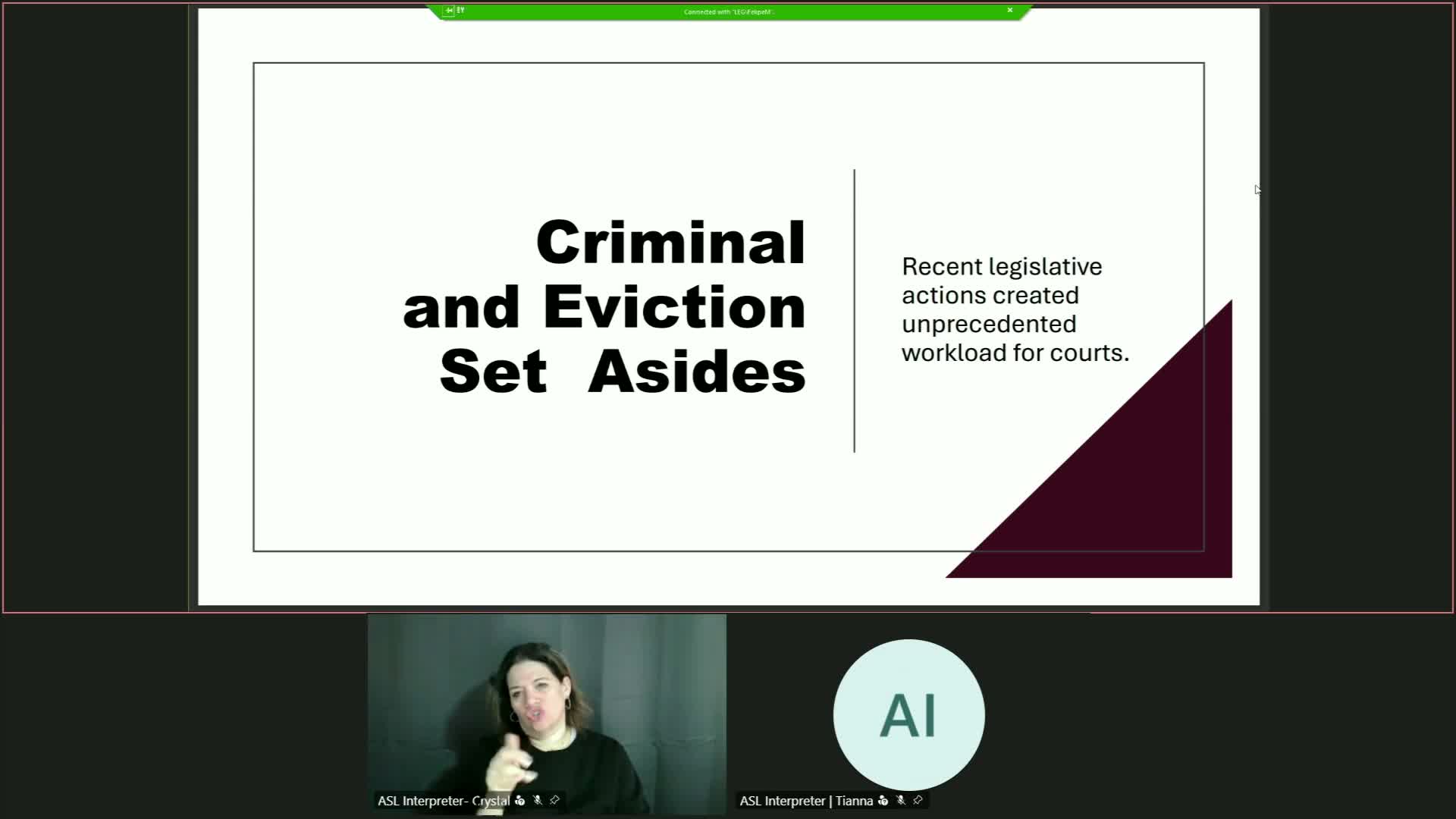
The Oregon Judicial Department told the Ways and Means Public Safety Subcommittee on Feb. 17 that recent statutory expansions have produced an “unfunded surge” in set-aside and sealing petitions, dramatically increasing court workload and producing a large eviction-case backlog.
Jessica Rozier, deputy state court administrator, said criminal set-aside filings went “from under 5,000 per year to over 25,000 annually,” driven in part by new legal clinics and firms filing high volumes in several counties. On the civil side, Rozier said House Bill 2001 introduced annual sealing of eligible eviction cases; OJD reviewed more than 168,000 eviction records with short-duration positions that expired in June 2025 and still has a backlog of roughly 75,000 eviction cases requiring manual review.
OJD proposed a combination of temporary and phased permanent positions to eliminate the eviction backlog (phasing out four eviction-review positions in 2027, after automation is implemented) and to resolve criminal set-aside backlogs by June 2029 while processing incoming petitions within statutory timelines. Rozier said automation and data integrations (for example, with Department of Revenue and employment records) could boost verification rates from about 40% today to near 100%, reducing manual work and enabling existing staff to manage volumes.
Ken Sancher, interim executive director of the Oregon Public Defense Commission, briefed the committee on a technical adjustment to prior budget assumptions: a revenue reconciliation identified a mismatch of about $952,073 between OJD and OPDC budget builds. OPDC requested an other‑fund limitation change to reconcile transfers; Sancher said the net impact would reduce OPDC’s court‑mandated hourly-attorney account by about $60,000, which OPDC intends to absorb without backfill.
Committee members cautioned about large IT procurements and asked OJD to identify existing state models that could be purchased instead of building unique systems. Legislators expressed general support for automation but urged caution on implementation and vendor accountability.
These items were presented as informational; the subcommittee did not take formal votes during the Feb. 17 hearings.