
House committee adopts amendment and forwards lodging-tax increase to House floor
Get AI-powered insights, summaries, and transcripts
Subscribe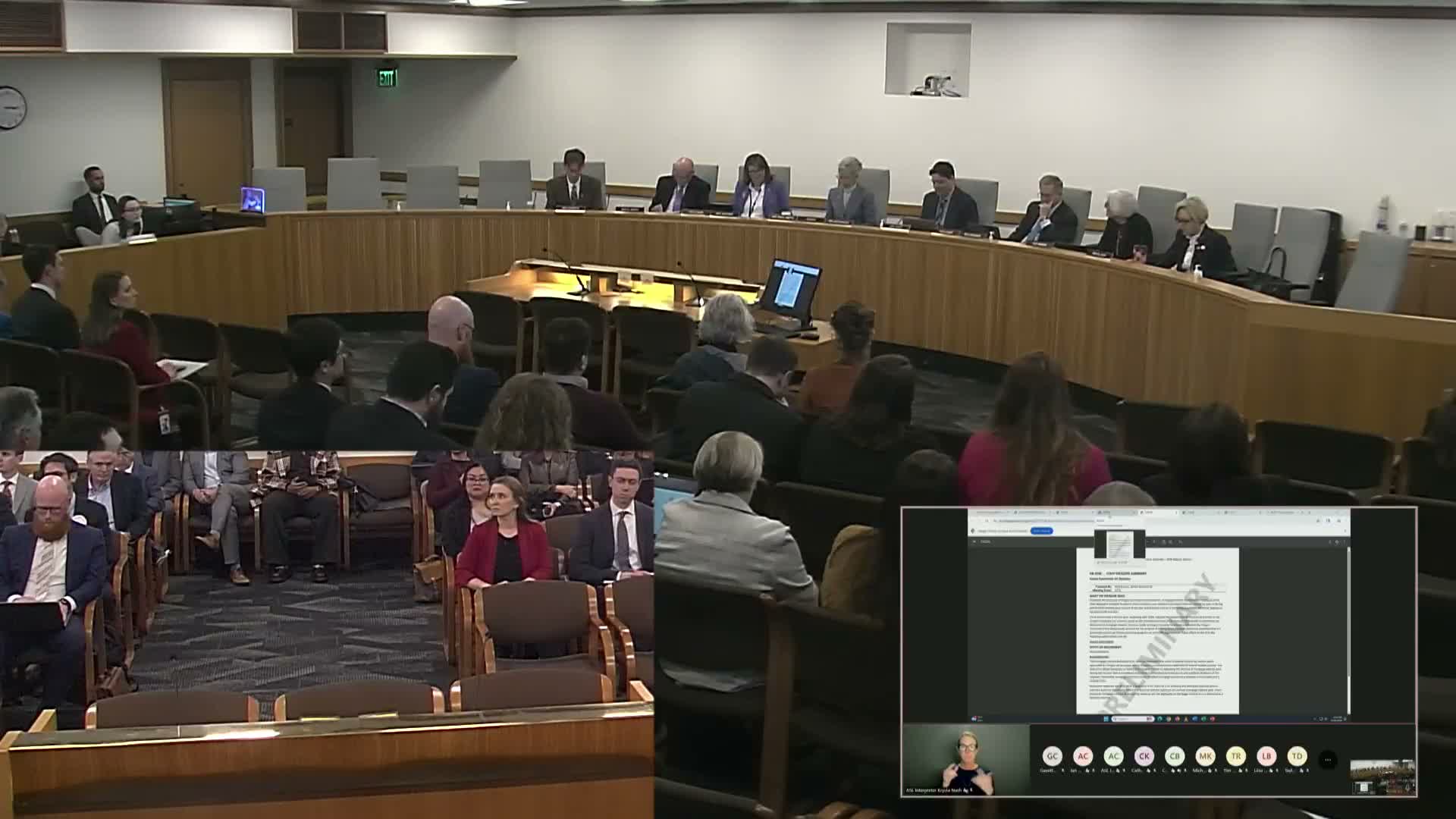
Summary
In a work session the committee adopted a dash-1 amendment to HB 4134 altering distributions of a proposed transient lodging tax increase, then voted to send the bill as amended to the House floor with a due-pass recommendation.
During a Feb. 16 work session, the House Revenue Committee moved and adopted the dash-1 amendment to House Bill 4134 and then voted to send the bill, as amended, to the House floor with a due-pass recommendation.
LRO staff outlined the bill’s proposal to increase the state transient lodging tax by 1.25 percentage points, with net revenue from 1.0 percentage point allocated to a Recovering Oregon Wildlife Fund subaccount under the dash-1 amendment and the remaining points distributed among several agencies. The dash-1 amendment as explained moves 0.9 percentage points to the wildlife fund subaccount and 0.1 percentage points to the Oregon Conservation Corps Fund; an alternate dash-3 amendment was discussed that would reduce the increase to 0.25 percentage points and direct funds to wolf management compensation and a related trust.
Representative Walters moved adoption of the dash-1 amendment dated 02/02/2026; after a brief clarification the committee adopted the amendment. Walters then moved that HB 4134 as amended be referred to the floor with a due-pass recommendation. The committee conducted a roll-call vote: Representative Hudson (Aye), Representative Levy (Yes), Representative March (Yes), President Smith (Aye), Vice Chair Roeschke (No), Vice Chair Volkers (Yes), Chair Daniels (Aye). The motion carried and the committee closed the work session.
Fiscal note cited by LRO staff: revenue impacts for the dash-1 amendment were presented as increases of approximately $6,700,000 in the 2025–27 biennium, $83,200,000 in 2027–29, and $89,500,000 in 2029–31 (as reported by the Legislative Revenue Office in committee testimony).