
Heated hearing on SB 1586 (Oregon Jobs Act) spotlights land‑use fight and new manufacturing R&D tax credit
Get AI-powered insights, summaries, and transcripts
Subscribe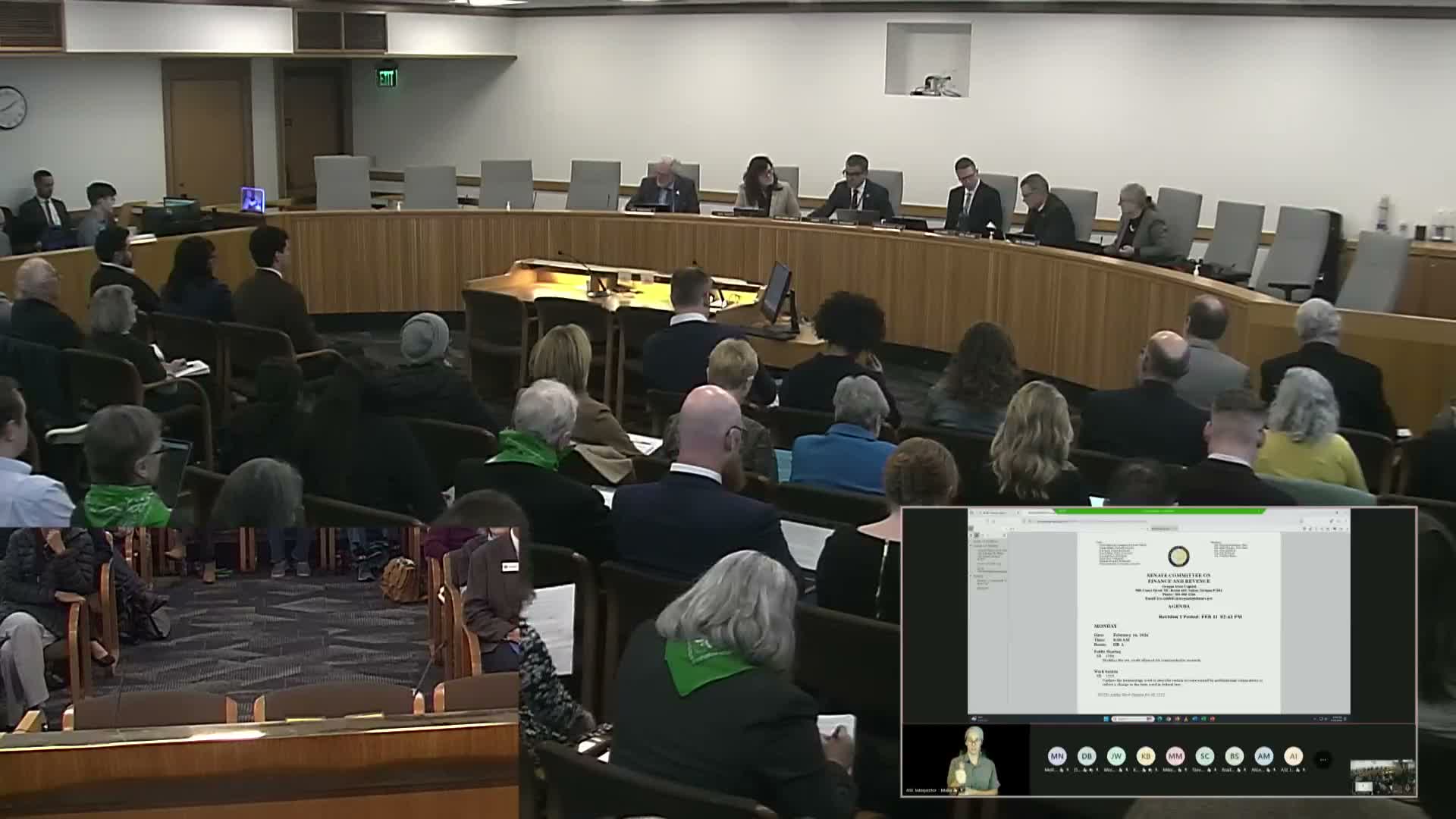
Summary
At a public hearing on Senate Bill 1586, proponents urged the bill’s potential to create family‑wage advanced manufacturing jobs and expand an R&D tax credit; opponents warned the bill would permanently convert about 1,700 acres of high‑value farmland, lack enforceable job guarantees and carry significant fiscal and environmental risks.
The Senate Finance and Revenue Committee opened a public hearing on Senate Bill 1586, the Oregon Jobs Act, on Feb. 16 and heard hours of testimony from lawmakers, local officials, business groups, conservation organizations and farmers over a proposed one‑time land use adjustment and an expansion of a state R&D tax credit.
Sponsor Senator Janine Salmon told the committee the bill is designed to "keep what we have, grow what we have and expand strategically," and described the Dash‑4 amendment as a compromise that would bring 373 acres into the urban growth boundary and designate roughly 1,400 acres as urban reserve. "This bill is about Oregon workers and families," Salmon said, urging the committee to "Listen, learn, act. Let's get Oregon back to work."
Congresswoman Janelle Bynum, a member of the joint semiconductor task force who testified in support, said the bill dovetails with federal and state investments and will help retain advanced manufacturing and life‑science jobs in Oregon. Industry witnesses, including representatives from Genentech, Caravel Bio and Oregon Life Sciences, said expanding the R&D tax credit beyond semiconductors would help companies invest and hire in the state.
Opponents concentrated on the land‑use component and environmental impacts. Washington County Commissioner Nafissa Fai urged the committee to "pause this bill given the impacted communities, the time and the input they deserve," arguing the scale of the proposal and the short session timeline precluded sufficient local analysis. Hillsboro city councilor Kimberly Sinclair said SB 1586 "represents a permanent rezoning of 1,700 acres of prime farmland" with no binding jobs requirements or enforceable benchmarks. Metro Councilor Mary Nolan said regional planning concluded the Portland metro area already has sufficient land for job growth and questioned the need to change land designations now.
Conservation and agricultural witnesses pressed similar themes: Nellie McAdams of the Oregon Agricultural Trust said about 1,500 of the 1,700 acres are actively farmed, and Dean Moberg of the Oregon Association of Conservation Districts warned that development would destroy prime class 1 and 2 soils. Water and watershed groups highlighted risks to streams and salmon habitat and said infrastructure costs and water availability had not been resolved.
Business and utility witnesses countered that Oregon lacks appropriately located and aggregated industrial land and that incentives and permitting predictability are necessary to compete with other states. Duke Shepherd (Oregon Business and Industry), Duncan Wise (Oregon Business Council) and Keith Levitt (Confluence Strategies) emphasized the need for scale and site readiness; Larry Beckettall of Portland General Electric discussed utility planning to serve any future development.
Policy groups raised fiscal concerns about the new manufacturing R&D credit. Daniel Hauser of the Oregon Center for Public Policy said SB 1586's expansion could cost the state tens of millions of dollars over the coming biennia and that the design risks favoring large firms over smaller innovators.
Chair Broadman closed the hearing after several hours and announced the committee would hold over remaining public testimony until Wednesday and requested Business Oregon and the bill sponsor to return with more detailed cost and program specifics for the R&D credit and regulatory changes. The committee did not take final action on SB 1586 on Feb. 16.