Oregon Eligibility Partnership warns HR 1 will add major staff workload and fiscal risk; agency seeks funding
Loading...
Summary
Oregon Eligibility Partnership Director Nate Singer told the Ways and Means Human Services Subcommittee that HR 1’s expanded work requirements and verification rules will increase workload drastically, and ODHS requested $131 million and roughly 452 positions in its December funding letter (revisions pending).
Oregon Eligibility Partnership Director Nate Singer told the Ways and Means Human Services Subcommittee on Feb. 16 that federal changes known in the briefing as "HR 1" substantially increase verification and work‑requirement obligations for SNAP and Medicaid, shifting fiscal and operational risk to the state and prompting an agency funding request.
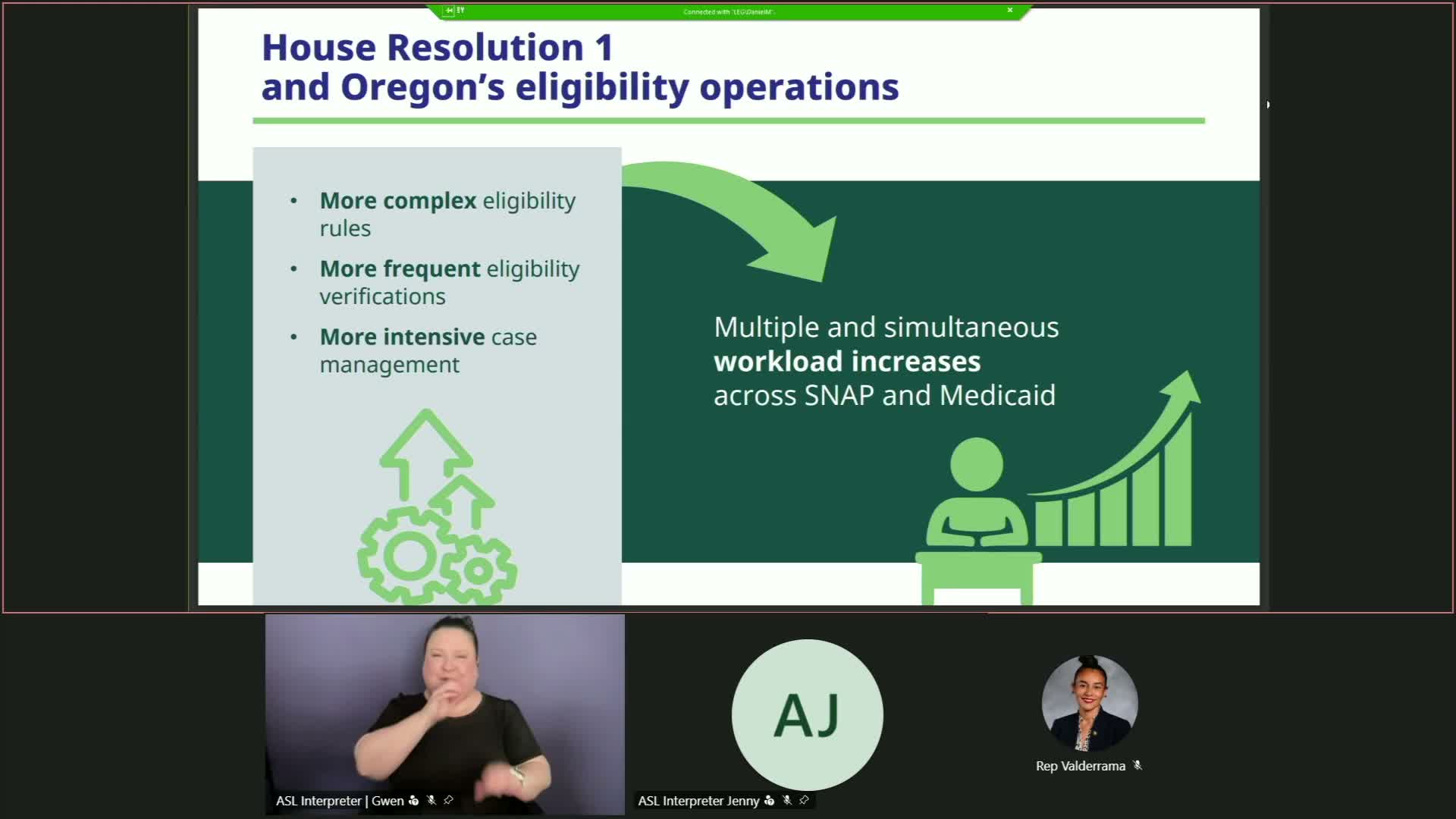
Singer said HR 1 requires more frequent verification, expanded work requirements and additional reporting that will mean more "touches" per case even where caseloads fall. "HR 1 moved the risk to states," Singer said. "If we do not interpret, implement, and adjust quickly and accurately, that risk becomes state risk." He warned of "hundreds of millions to billions" in fiscal exposure if the state cannot meet the new requirements.
Singer and ODHS officials supplied several quantifications: OEP serves more than 1,500,000 Oregonians; the agency reported staff handled over 3.6 million human interactions in 2025 and processed more than 2 million tasks. Singer said roughly 600,000 to 650,000 adults could face new Medicaid work requirements, and the agency cited a potential Medicaid withholding scenario of as much as $422,000,000 per month until compliance is achieved. For SNAP, Singer cited a possible state liability and described a new federal penalty structure tied to error rates.
The agency’s December funding ask, presented by Rob Cordiri, sought $131,000,000 in general fund and about 452 positions for DHS; Cordiri and Singer said some numbers were being refined as they lived with new data. Singer said the agency is using overtime (about 20,000 hours per month) and other short‑term measures now but called those approaches unsustainable and warned they lead to burnout, turnover and higher error rates.
Singer described several concrete HR 1 impacts that increase staff time: recalculation of utility allowances for SNAP, changes to noncitizen eligibility that required reprocessing cases, expansion of SNAP work requirements from six counties to all 36 counties, the need to update a long policy manual and retrain staff, and the first‑ever work requirements for certain medical programs. He said automation helps (about half of some ACA medical cases can be processed without worker intervention), but only about 45% of consumers use online tools, limiting efficiency gains.
Committee members asked follow‑up questions about technology, alignment across programs (for example, Healthier Oregon vs. SNAP/Medicaid), and whether the agency can reduce requests based on updated exemption counts. Singer said the agency is building system flexibility and working with federal guidance but emphasized that some federal rules remain unclear and that implementation windows are short.
No formal committee action was taken; ODHS said it would follow up with revised numbers and documentation.