Get Full Government Meeting Transcripts, Videos, & Alerts Forever!
Get email alerts on the Ocpa topic
No spam. Unsubscribe anytime.
Consumer advocates tell committee Oregonians have rights under OCPA but gaps remain
Summary
Oregon Consumer Justice summarized rights under the Oregon Consumer Privacy Act, noted universal browser opt-outs do not cover apps, highlighted thresholds that leave some businesses uncovered, and raised concerns about targeted advertising and dynamic pricing that may harm low-income consumers.
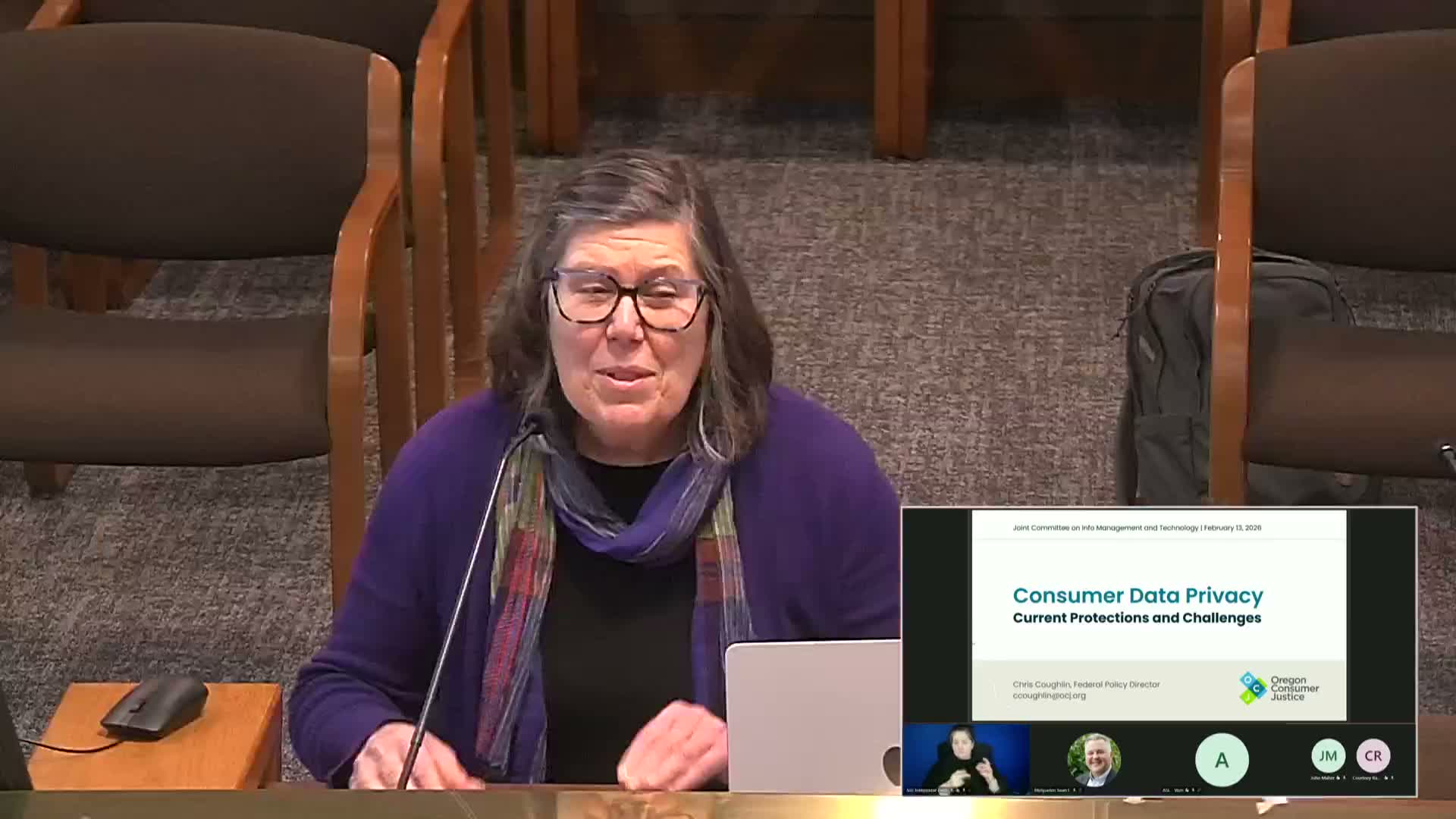
Chris Coughlin, federal policy director at Oregon Consumer Justice, briefed the Joint Committee on Information Management and Technology on Feb. 13 about consumer rights and gaps in Oregons data privacy framework.
Coughlin listed current OCPA rights: consumers can request lists of entities that received their data, opt out, obtain copies of personal and sensitive data held by businesses, correct inaccuracies and request deletion. He noted Senate Bill 619 established the Oregon Consumer Privacy Act and that states including Connecticut and Colorado served as models; later changes in 2025 through House Bill 2008 extended protections for precise geolocation data and for some youth categories.
Coughlin described thresholds that determine which businesses fall under the law: entities that derive 25% or more of annual gross revenue from selling personal data, or businesses holding personal data on at least 100,000 Oregon residents, are covered. He emphasized that the law includes nonprofits and that some large nonprofits (for example, public broadcasters) may meet the 100,000-consumer threshold.
On enforcement, Coughlin said the attorney general leads enforcement; the law lacks a private right of action for consumers. He also described a new universal opt-out setting available through web browsers, but said it does not cover apps or other non-browser data collection methods. "Apps on your phone...would not be covered through the universal opt out," he told the committee.
Coughlin warned of commercial practices that use data for psychological targeting and dynamic pricing. He cited a recent report finding grocery-item prices differing by as much as 23% between customers on a major delivery platform and said regulators and policymakers should watch how individualized pricing could disproportionately hurt lower-income residents. When asked whether dynamic pricing could affect people with lower incomes, Coughlin said he would get more information for the committee.
Coughlin also described outreach efforts: Oregon Consumer Justice convened a data privacy cohort, produced materials to help navigate the data broker registry and released a digital privacy comic in partnership with AgePlus to assist older Oregonians and others in exercising their rights.
Committee members asked for examples of businesses that meet OCPA thresholds and whether practices like dynamic pricing and digital shelf tags appear in Oregon stores; presenters said some examples exist nationally, and additional research and industry vetting would be necessary before proposing legislative fixes.