Get Full Government Meeting Transcripts, Videos, & Alerts Forever!
Get email alerts on the School Budget topic
No spam. Unsubscribe anytime.
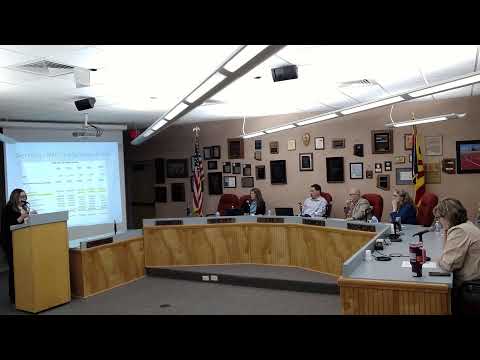
Sierra Vista work session: consultant outlines how enrollment drop and one-time funds shape FY26 budget
Summary
At a Sierra Vista Unified District work session, consultant Sarah Kirk walked the board through how declining enrollment, weighted ADM and one-time legislative funds affect the district's M&O and capital budgets; board members asked about transfers from DAA, dwindling carryforward reserves and staffing implications.
Sarah Kirk, a budget consultant who presented to the Sierra Vista Unified District governing board, told trustees the district's falling enrollment is the primary driver behind pressing budget choices and warned that state funding rules make the district's operating revenue sensitive to current-year Average Daily Membership (ADM). "The main thing that drives our budget is going to be ADM," Kirk said, explaining that recent changes mean the base support level is now funded on current-year enrollment.
Kirk showed five-year ADM data indicating Sierra Vista declined from about 4,400 ADM in 2022 to roughly 3,500 in the latest revised budget, saying that drop is producing "some of these difficult decisions" the district faces. She described the statutory revenue-control limit (RCL) and how it is derived from weighted ADM: grade-based "group A" weights, program-based "group B" weights (for special education, ELL, gifted and similar categories), the teacher experience index and a transportation component.
Kirk told trustees the district's carryforward (the budget balance brought forward) for FY26 is $2,700,000 and that the district's unrestricted capital outlay (DAA) for FY26 is about $2,300,000. She explained that one-time legislative appropriations — such as the state aid supplement tied to Proposition 301, one-time FRPL allocations and one-time DAA — are distributed proportionally but cannot be relied on for long-range planning because each is tied to the annual state budget process.
On the question of transfers between funds, Kirk said a district may transfer current-year DAA into M&O to relieve operating pressure, but the DAA carryforward cannot be moved. She noted an ARS provision (cited in the presentation as "15 ARS 15 9 15") allows budget and AFR revisions going back up to three years, and discussed how reopening a prior-year budget could be used to reclassify some transfers within the statutory rules.
Trustees pressed staff on the financial risks. Kirk and board members acknowledged the district has been using current-year DAA to support operations and that state reviewers flag that pattern as a risk. "That is that risk factor," Kirk said, describing the district's move of DAA into M&O and the reduction in reserves from roughly $5 million to $2.7 million in recent years. She also confirmed the district's M&O fund shows deficit cash at the county treasury even though the RCL is the statutory spending limit; she said she is researching the revenue shortfalls and has requested county data to reconcile levies, collections and state aid receipts.
Superintendent Terry Romo described actions to respond to the shortfall, including an earlier open-enrollment campaign and plans to staff next year based on spring-break enrollment. Romo said the district would use attrition where possible and develop a staffing model that ties positions to enrollment thresholds. "We will not be in the negative no matter what it takes," Romo told the board.
Board members asked about absenteeism's effect on ADM and about options such as overrides or reclassifying funds. Kirk explained federal grants, maintenance-of-effort rules and cash-control versus budget-control funds, and she reiterated the challenge of projecting one-time legislative funds.
Votes at a glance: the published meeting agenda was adopted by motion and passed 4-0 with one member absent; a later motion to adjourn also passed 4-0.
Kirk summarized guidance for trustees: monitor weighted ADM trends by grade and program, track carryforward and DAA transfers carefully, require clear documentation for any budget revisions, and avoid relying on one-time state appropriations for recurring expenses. The board concluded the work session with follow-up research assigned to staff on the district's cash shortfall and a plan to revisit staffing decisions after spring-break enrollment.