
TRPA outlines EIS scoping for housing-focused policy changes; residents press for wildfire and cumulative-impact analysis
Get AI-powered insights, summaries, and transcripts
Sign Up Free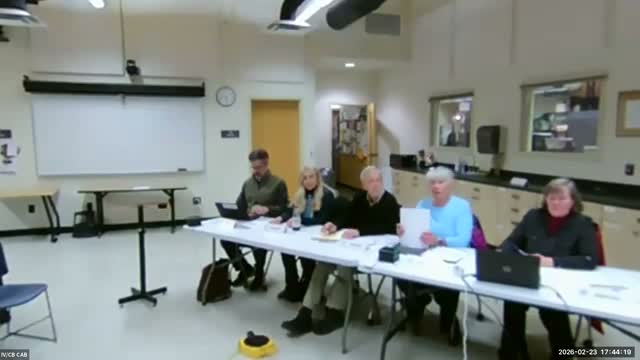
Summary
Tahoe Regional Planning Agency (TRPA) planners briefed the Washoe County Community Advisory Board on a programmatic Environmental Impact Statement scoping period for policy changes to support workforce housing; residents urged priority study of wildfire evacuation and cumulative impacts from recent phase 2 approvals and large projects. Comments on scope are due March 16.
At a Washoe County Community Advisory Board meeting, Jacob Straub, a senior planner with the Tahoe Regional Planning Agency (TRPA), explained that TRPA's governing board in January authorized a programmatic Environmental Impact Statement (EIS) to study a package of policy and code changes intended to speed and lower the cost of workforce housing while maintaining the agency's environmental thresholds. Straub said the public scoping period runs through March 16 and that the EIS will analyze a suite of resource areas, including land use, water quality, scenic quality, transportation, public safety and hazards such as wildfire and evacuation.
"An EIS is our highest level of environmental analysis at TRPA," Straub said, describing the EIS as the "envelope or the sandbox of study for potential policy and code changes" and emphasizing that scoping comments will shape what is studied. He told the board that comments can be submitted by email to housing@trpa.gov and that the scoping summary will be posted on TRPA's major projects web page.
Board members and residents used the forum to press TRPA on three recurring concerns. Several speakers urged that wildfire and evacuation analysis be elevated in importance. "Wildfire and evacuation should be number 1 because it impacts every single thing on them," a resident said, warning that a fire would affect wildlife, water quality and public safety. Straub said he was taking notes and that the EIS could analyze hazards and evacuation as a discrete topic or within cumulative effects, but he did not commit to a specific analytic approach on the spot.
Several participants asked whether TRPA would treat the phase 2 amendments (which increased height, density and coverage in some town centers) as a baseline condition or study their effects cumulatively. Anne Nichols, representing a preservation group, criticized unit-based metrics and statistical measures: "In a resort region where peak occupancy far exceeds resident population, counting units is not the same as managing environmental load capacity," she said, urging TRPA to explain how metrics such as vehicle miles traveled per capita will reflect real-world congestion and evacuation risk. Straub said cumulative effects analysis could include existing policies such as phase 2, but he did not provide a definitive yes/no commitment during the meeting and invited written comments to clarify the scope.
Residents also flagged pending projects in Kings Beach and nearby communities — including a 157-unit proposal and other developments they said would add hundreds of units, commercial space and tourist accommodation units — and asked that those projects be considered in the EIS cumulative analysis. Straub said the programmatic EIS can examine potential physical projects that could result from the proposed policy changes as part of a cumulative-effects assessment.
The TRPA presentation stressed that the scoping period is not the time to alter project proposals; rather, it is the time to suggest what environmental impacts TRPA should study. Straub outlined a tentative timeline: a draft EIS and additional public comment period in the summer, with a final EIS and policy proposal expected in the fall of 2027.
The CAB also handled routine business. Diane Becker moved to approve the January minutes; the motion was seconded and carried with a recorded series of "Aye" votes. Chris Wood later moved to adjourn; the motion was seconded and the board voted to adjourn.
The TRPA scoping comment deadline is March 16. TRPA has posted project materials and a scoping summary on its major projects page, and staff said written comments or questions can be submitted to housing@trpa.gov.