Get Full Government Meeting Transcripts, Videos, & Alerts Forever!
Get email alerts on the Municipal Finance topic
No spam. Unsubscribe anytime.
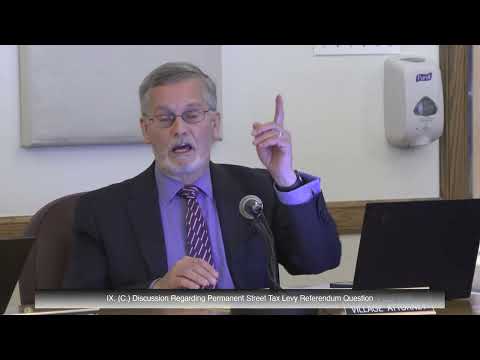
Riverside staff recommends ballot question to convert street-and-bridge bond levy into annual tax levy
Summary
A village staff member recommended the Village of Riverside put a PTELL ballot question before residents to convert the existing debt-service levy for roads into an annual street-and-bridge tax, arguing the move preserves funding continuity and avoids costly new bond borrowing. No formal vote was recorded in the transcript.
A village staff member recommended that the Village of Riverside place a ballot question before residents to convert the village’s debt-service levy for street and bridge work into an annual tax levy under the Property Tax Extension Limitation Law (PTELL).
The presenter told the village board that PTELL ordinarily limits annual increases to either the consumer price index or 5%—whichever is less—but the statute includes three exceptions. The staff recommended using the PTELL “extension limitation” option, a one-year increase above the 5% cap whose higher levy base then carries forward in future years, allowing the village to continue road investments without issuing new bonds.
"That option would allow the village to get that question before the village residents immediately and it would allow that switch from debt service levy to an annual levy right away," the staff member said, arguing the approach would maintain the current program for road improvements.
The presenter said the board could also discontinue the current street levy for the 2024 tax year and then place a new street-and-bridge tax question on a later ballot. Under the draft language discussed, the alternative question would authorize a 0.1% tax of equalized assessed valuation for street and bridge purposes. The staff member cautioned that discontinuing the levy would produce roughly $0 in revenue this year and cause tax bills to drop then rise again if voters later approve a new tax.
"If we want to maintain the level tax levy for the residents and be able to continue the program for road improvements that we have been doing, the only choice we have would be this question," the staff member said.
The packet circulated to the board contained the statutorily prescribed ballot language and a draft resolution. The presenter emphasized that the statute prescribes the form of the question and that the packet fills in the village name, the proposed percentage and the number of years where required. The staff member also recommended coupling placement of the question with a robust informational campaign, noting that the village may inform residents but may not advocate for the measure.
Comparing financing options, the presenter said the village issued bonds in February 2014 in a low-interest environment (when the federal funds rate was under 1%), and that issuing new bonds now would not produce the same savings. Converting to an annual levy, the staff said, would avoid borrowing costs and preserve near-term road investment.
Responding to a question from President Pollock about legally earmarking funds, the staff member said the board could adopt an ordinance to specify how levy proceeds are used.
No formal vote or motion to place the question on the ballot was recorded in the transcript. The next procedural step is for the village board to decide whether to adopt the draft resolution and place the question before voters and to finalize any accompanying informational materials.