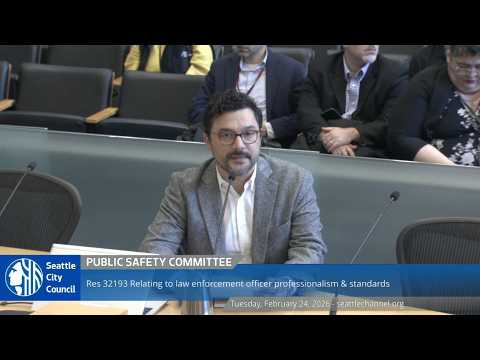
City briefs council on expansion and limits of unarmed alternative 911 responses
Loading...
Summary
Fire Department, CARE, and SPD briefed the Public Safety Committee on alternative response programs: SFD's HealthONE expansion and overdose work, CARE's responder limits under a SPA contract and plans to double capacity, and SPD's CSO/CRT/POET teams. Council members pressed for clarity on labor, private-property exclusions, and criteria-based dispatch.
Seattle's public-safety leaders briefed the City Council Public Safety Committee on Feb. 24 about the city's multi-agency effort to expand unarmed or civilian-led responses to certain 911 calls.
Lisonbee Holcomb of the Mayor's office introduced the panel and said Mayor Katie Wilson supports sending "the right training and proficiencies to match the need." Fire Chief Harold Scoggins described the Mobile Integrated Health (MIH/HealthONE) program's evolution since 2019, its partnership with the Human Services Department, and operational growth. MIH staff said they currently run with roughly 11 HSD case managers and a pool of trained firefighters that will expand toward 50 next year; typical HealthONE deployments use two firefighters and one case manager and have an average on-scene time of about 42 minutes. Chief Scoggins highlighted sustained ED-diversion work and a new EMT buprenorphine protocol with over 140 administrations reported by SFD.
CARE (Community Assisted Response and Engagement) briefed next. The CARE responder pilot launched in Oct. 2023 and expanded to 24 responders citywide; staff said the department plans to grow to 48 responders and nine supervisors this year. Chief Barton described operational constraints under the current SPA contract and a care MOU: CARE responders currently are limited by exclusions that prevent solo dispatch to some private-property settings (for example, parking lots that may be trespassable) and calls with visible narcotics paraphernalia. Barton said those limits and dispatch practices mean the 24 responders are functioning at roughly 28% of potential capacity and urged changes in dispatch criteria and administrative support to scale the program.
SPD Chief Barnes and Assistant Chief Tyrone Davis described Community Service Officers (CSOs), the Crisis Response Team (CRT), and police-co-responder models. Barnes said CSOs are non-commissioned and unarmed, and in 2025 CSOs responded to about 8,900 CAD calls (a 100% increase from 2024). He said CRT pairs specially trained officers with mental health professionals and that SPD recovered 2,071 firearms in 2025 through crisis and other operations.
Councilmembers used the Q&A to press on three topics: (1) whether CARE's private-property exclusions could be reconsidered without additional state-side legal changes or bargaining; (2) how criteria-based dispatch would be implemented (the panel said the city is moving to a 4-option phone triage and new dispatch protocols soon); and (3) training and supervisory capacity across CSO, MIH and CARE teams. Panelists said the mayor's office and City Attorney are reviewing bargaining and MOU interpretations and that some administrative fixes and CAD/RMS integration could increase CARE dispatch rates.
Why it matters: The briefing outlined how Seattle is reallocating responses for behavioral-health and low-acuity incidents away from armed patrols toward clinical, case-managed teams and civilian responders, while highlighting legal, labor and logistical barriers that limit faster expansion. Committee members requested follow-up materials on training curricula, the bargaining implications of private-property response, and specific timelines for planned expansions and dispatch changes.
Next steps: Panelists and central staff will return with more detailed legal guidance, clarified MOU language if needed, and implementation milestones at future briefings.