Get Full Government Meeting Transcripts, Videos, & Alerts Forever!
Get email alerts on the County Priority Mapping topic
No spam. Unsubscribe anytime.
Prince George's County retreat lays out committee priorities: housing, stormwater, transit, hiring and childcare
Summary
Council members and committee directors at the Prince George's County retreat mapped priorities across committees — affordable housing and zoning efficiency, stormwater and flood mitigation, transit station maintenance and security, procurement/hiring reform, and childcare/early learning — and directed staff to schedule briefings.
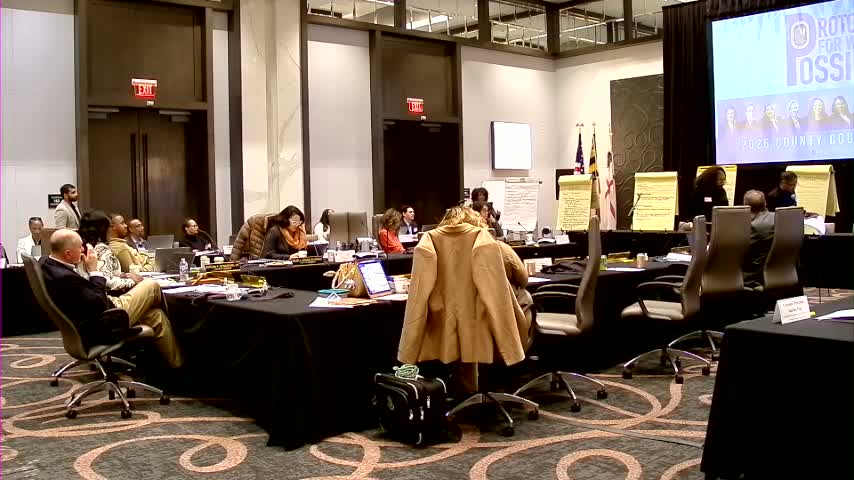
At a two-day retreat, Prince George's County council members and committee directors outlined a yearlong workplan that focuses on housing affordability, stormwater management, transportation reliability, procurement and hiring reforms, and early-childhood services.
Committee directors presented summaries of breakout sessions and asked staff to pursue briefings and data collections. Raina Hightower and Shaelyn Miller Y (PHED) recommended a comprehensive economic development strategy, auditing EDI and FSC funds, an inventory of vacant properties for development opportunities, zoning-efficiency reforms and a suite of affordable-housing tools including community housing trusts and land banking.
Kenneth Battle, director of Transportation, Infrastructure, Energy and Environment (TIEE), grouped priorities into three themes: environmental ecosystem improvements (stormwater inventories, solid-waste contract reviews and floodplain construction issues), transportation safety and system reliability (road resurfacing, transit-station flood exposure and purple line security), and quality-of-life enforcement (property standards, nuisance abatement and animal-welfare initiatives).
Budget and procurement modernization came up in GOFP briefings: staff recommended improving public budget transparency and the county website, performance-management tools (311 and CountyStat integration), procurement and contract-payment reforms, and a review of hiring and retention practices including fingerprinting and other administrative bottlenecks.
Health, human services and public safety priorities included expanding school-based health centers, youth-housing prevention, maternal-health coordination, and behavioral-health capacity (the committee flagged a legislative funding request for behavioral-health services). The Education and Workforce Development committee urged expansion of early-childhood readiness, career and technical education aligned to labor demand, library-centered community infrastructure and stronger employer engagement to support displaced federal workers.
Chairs asked staff to schedule briefings with DPIE, WSSC, DOE and WMATA where appropriate and to produce a prioritized impact/effort map for council review. The retreat concluded with the chair promising a written report detailing committee top priorities and next steps.