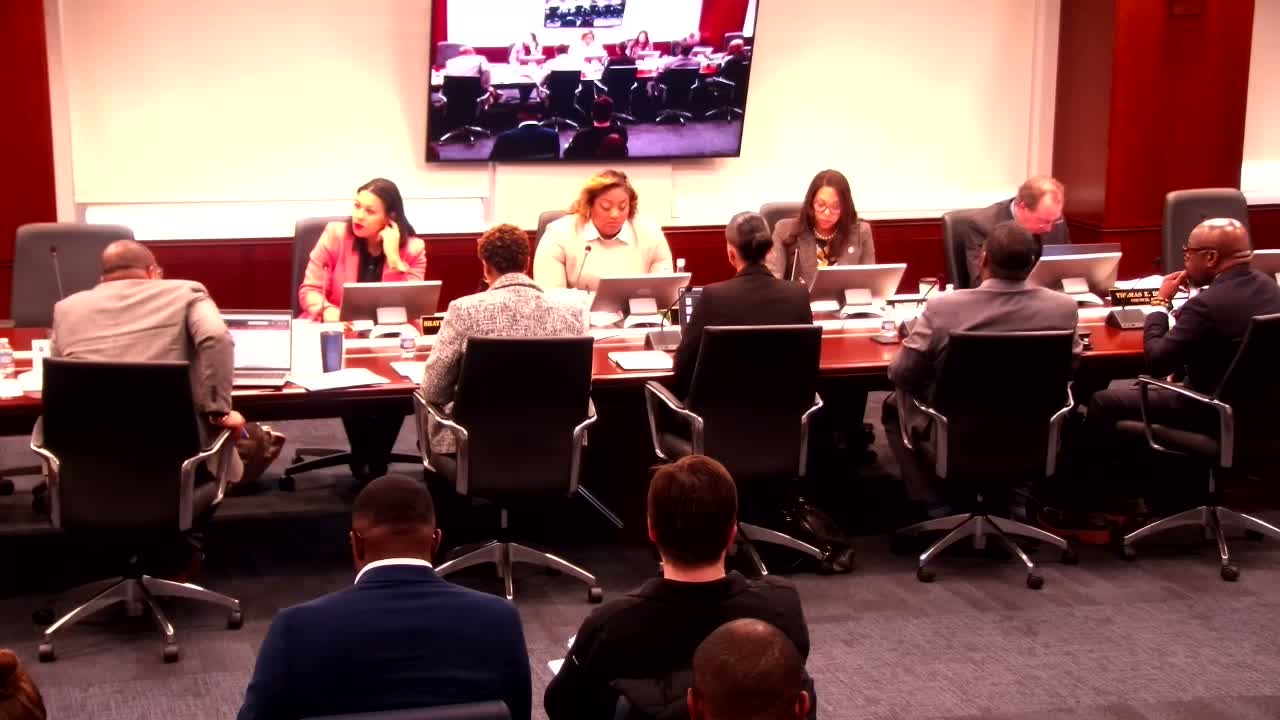
Prince George's County school board asks council for wide-ranging funding and policy support
Loading...
Summary
Prince George's County Public Schools leaders told the county council they need major new funding and policy support — including an immediate capital gap estimate and program requests for special education and multilingual learners — as they outlined a legislative platform for the 2026 session.
Prince George's County School Board leaders on Feb. 17 urged the county council to back a sweeping set of funding and policy priorities aimed at addressing a backlog of building repairs, growing special-education needs and support for multilingual learners.
"We're gonna ask you for 3,000,000,000 plus another 50,000,000," said Dr. Felton Moss, the board's presenter, summarizing the scale of the district's upcoming budget requests. He and vice chair Amy Olivia outlined four legislative priorities and 10 measures the board says are necessary for student success.
The board listed four top priorities: increasing supports for students with disabilities; boosting academic programs for multilingual learners; modernizing school construction and facilities funding; and ensuring safe, secure learning environments. On special education, Moss noted a recent 140 percent increase in students identified with autism over the last decade and said the district saw an additional 500 students identified last school year. "We need to urgently address the growth in our population," he said.
On multilingual learners, the board requested $305,000 annually to fund three additional multilingual family support coordinators and asked for funding to expand dual-language programs and assessments. The board requested $100,000 annually to expand the seal of biliteracy assessments for 12th graders and an additional $469,000 for assessments for ninth through 11th grades so students can be tested in native languages.
The presenters framed capital needs as urgent. Vice chair Allevo said the district needs roughly $570,000,000 per year for ongoing maintenance and that the county and state currently provide about $180,000,000, leaving an annual shortfall of roughly $390,000,000. "Every year we get further and further behind," she said, urging the council to consider ways to increase local and state investment and to examine the county contribution to the capital improvement program.
Board officials described programmatic work already underway: literacy "labs" in two District 7 schools and a districtwide literacy-coach pilot, steps they said are designed to improve reading outcomes over several years. On safety, they noted metal detectors in high schools have coincided with reductions in weapons on campuses and discussed exploring technology such as vape detectors and AI-capable alert systems.
Council members pressed the board on implementation details and accountability. One council member criticized past school construction choices and alleged wasteful spending in prior projects; Dr. Moss responded that while the board welcomes scrutiny, the district also needs deeper state and local investment to address structural maintenance arrears.
The school board asked the council to coordinate with state delegates and senators to avoid duplicate or unfunded mandates. Chair Waneka Fisher asked the board to flag legislation as it moves through Annapolis so the council and board can remain aligned. The presentation concluded with the council thanking the board and adjourning the committee.
Next steps: the board will continue to advocate for the listed legislative priorities in Annapolis and the council said it would follow up on the board's funding requests and suggested clarifying proposals for pedestrian safety and other items.