
District unveils classroom AI framework and safe tools as part of broader tech updates
Get AI-powered insights, summaries, and transcripts
Subscribe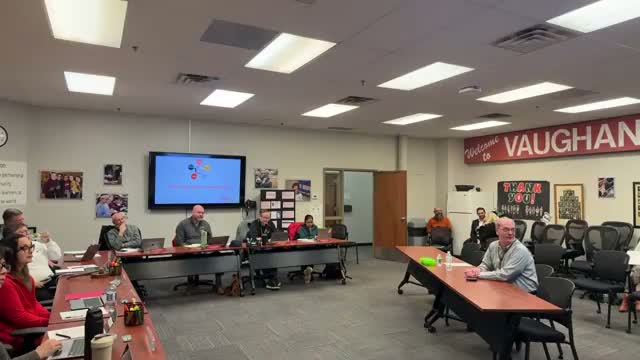
Summary
Technology and learning leads previewed a categorical framework for how AI may be used in instruction, recommended an entry‑level tool (Magic School) for K–12, and said AI guidance has been added to the student handbook as an extension of academic integrity rules.
District technology and instructional staff presented an AI‑use framework at the Feb. 9 work session that divides classroom activities into use‑case buckets (planning, research, create, review, refine, interact) and describes when and how teachers may permit students to use AI.
Eric Hills, identified as a district learning coordinator, said the intent is to avoid treating AI as an all‑or‑nothing prohibition and instead to provide explicit guidance for teachers on what is allowed for a given assignment. "This is what we expect, make it clear, and not have to hunt down all the time," he said.
Staff highlighted Magic School as a vetted K–12 entry point: a protected environment district teachers can assign and monitor. Hills and other staff said more powerful models (for example, Gemini) are available for staff use but are not broadly open to students without additional safeguards.
The district already includes AI language under academic integrity in high‑school handbooks and plans to keep handbook language as the baseline for misuse or cheating; staff said they will break out more specific policy if technology evolves to require it. Questions from board members covered hallucination risks, training for teachers on crafting prompts and classroom monitoring.
Beyond AI, staff previewed NextPath, a consolidated student data/intervention system meant to reduce manual data extraction and centralize intervention plans for MTSS. Technology and instructional leaders said they will return with implementation details and PD plans.
What happens next: Staff will continue PD and PLC outreach to bring teachers on board with the framework, finalize handbook language as needed, and present NextPath details in a future meeting.