Get Full Government Meeting Transcripts, Videos, & Alerts Forever!
Get email alerts on the White House Eo topic
No spam. Unsubscribe anytime.
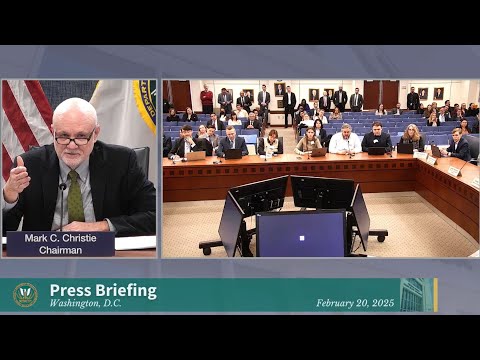
FERC chair says White House executive order mostly consolidates past practice, seeks details for routine dockets
Summary
FERC Chairman Christie told reporters the White House executive order largely collects longstanding practices—OMB budget review, OIRA regulatory review, CEQ NEPA guidance—and stressed FERC will follow statutory limits in contested dockets while seeking clarification on how the EO applies to routine cases.
FERC Chairman Christie said the White House executive order affecting independent agencies "largely" packages existing practices into a single directive but, he added, the commission will seek clarification about how it applies to everyday contested dockets. "At the end of the day, we follow the law," Christie said, emphasizing FERC's obligations under the Federal Power Act, the Natural Gas Act, the Administrative Procedure Act and NEPA.
Christie told reporters the EO appears aimed at "big sweeping regulations" rather than the thousands of routine cases that arrive at FERC — mergers under Section 203, rate and tariff matters under Section 205 and market-related complaints under Section 206 — and said he does not expect OMB or DOJ to weigh in on every garden‑variety filing. He highlighted what he called the EO's "savings clause," quoting that "nothing in here affects existing law or the ... authority of any agency under existing law," and said he will take that provision at face value while seeking further detail from the relevant offices.
Reporters pressed whether the EO, combined with a recent Department of Justice memo and litigation over Humphrey's Executor protections, could enable improper White House influence or threaten commissioner tenure. Christie acknowledged the legal issue will be litigated in the courts and noted that under the DOE Organization Act the president appoints and may remove the chair. He reiterated that contested proceedings must remain on the record and are protected from ex parte communications.
On whether White House or DOJ legal positions could limit commissioners' ability to dissent, Christie said coordination with DOJ on appeals has long been practice: DOJ often handles Supreme Court‑level appeals while declining routine matters. "Most of the time DOJ says, thanks. You do it because we don't—we got enough work of our own," he said, adding that DOJ historically decides whether to take cases to the Supreme Court.
Christie said the administration may file positions in FERC dockets — for example, the Secretary of Energy or other agencies can comment on proceedings — but any such input must be placed on the record. He said the commission will apply statutes and ex parte rules in adjudications and will seek clarifying guidance where the EO raises questions about terms such as "regulatory actions."