Get Full Government Meeting Transcripts, Videos, & Alerts Forever!
Get email alerts on the Environment Forestry topic
No spam. Unsubscribe anytime.
Consultant: Overabundant deer have stripped understory at Dobbs Ferry preserve; monitoring, invasive removal recommended
Summary
A consultant told the Dobbs Ferry Board of Trustees that high white-tailed deer density has reduced understory vegetation and midstory regeneration in the village preserve, raising erosion and habitat concerns; she recommended monitoring every two to three years and active invasive-species management to restore forest structure.
Danielle Begley Miller, founder and CEO of Forest Management Solutions LLC, told the Dobbs Ferry Board of Trustees on Jan. 20 that her deer-impact assessment of the village preserve found ‘‘overwhelming evidence’’ of high deer numbers and heavy browsing that have left the understory sparse and reduced midstory regeneration.
Miller said white-tailed deer can have outsized effects on forest structure because of feeding habits: ‘‘a 100-pound deer eat somewhere between 6 and 8 pounds of vegetation per day,’’ she told the board, and that intensive browsing produces a clear ‘‘browse line’’ with lush growth above 6 feet and near-total removal below that height. The assessment surveyed five representative sites and recorded every seedling, shrub and invasive species in four subplots at each location.
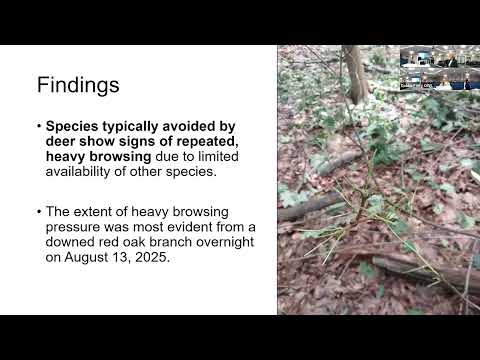
The consultant reported that, despite a healthy overstory, there was very little persistent mid-level regeneration (plants 8—6 inches and above were largely absent). She recorded 13 unique invasive species across survey plots and observed rapid consumption of downed foliage: on one occasion, deer removed all leaves from a fallen red oak branch within 24 hours between sampling visits, evidence she said of strong browse pressure.
Miller said the findings indicate two principal management implications: first, natural regeneration can rebound if browsing pressure is reduced; second, managers should pair deer management with active invasive-species removal and light-gap treatments at sites with emerging native seedlings. Her written recommendations, she said, call for vegetation monitoring every two to three years rather than annually and for prioritized invasive removals in light gaps and openings.
Matthew Svenenson, chair of the Conservation Advisory Board, said the preserve—indings align with observations in other village woods and noted downstream impacts: ‘‘there's been a huge amount of erosion, feeding into Wicker's Creek,’’ he said, describing trail erosion and denuded understories at multiple local parcels.
Trustees asked whether the preserve ssessment could be extrapolated to smaller woodlots. Miller said deer home ranges can cover about a square mile and animals move among parcels, so local management in the preserve would likely provide benefits beyond that single property, but she cautioned that small, edge-dominated woodlots may display different invasive pressures.
Next steps discussed at the meeting included placing a reminder to revisit the preserve in about a year, seeking additional funding or volunteer capacity for invasive removals, and incorporating Miller's monitoring protocol into the village eer-management plan. No formal policy was adopted at the meeting; the board invited further discussion and public comment during future meetings.