
Santa Fe council hears feasibility study, SHPO warns removal is an 'adverse effect' and mayor to seek temporary museum display
Get AI-powered insights, summaries, and transcripts
Subscribe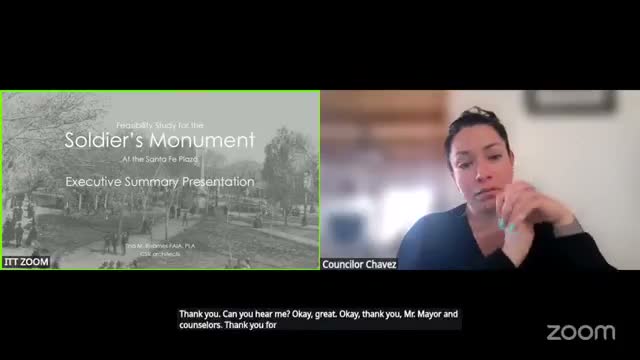
Summary
City staff and CSR Architects presented four options for the damaged Soldiers Monument in the Plaza and the State Historic Preservation Office said removing the monument could constitute an adverse effect under state law; the mayor said he will introduce a resolution to temporarily place fragments in the New Mexico History Museum while the city follows SHPO’s public‑hearing process and awaits the VA’s response on relocation.
Santa Fe Mayor Michael Garcia told the City Council on Feb. 24 that he will introduce a resolution to temporarily place the broken fragments of the Soldiers Monument in the New Mexico History Museum so the public can inspect them in person while the city completes required consultations and public processes.
The announcement came after Tina Reems of CSR Architects presented a feasibility study that evaluated four options for the 19th‑century obelisk — rebuilding with historic stone, rebuilding with a mix of historic and new material, rebuilding at a new site, or a limited cleanup/repair option — and provided high‑level cost estimates. Reems told the council the report was based on visual inspection only and that additional structural observation and a stone conservator would be needed for design and rebuilding work. "All options are ultimately inconclusive based on structural findings and further structural observation and design needed for the rebuilding of the monument," she said.
Why this matters: The study gives the council technical and cost detail as it weighs competing public demands: many Indigenous and community members urged removal or permanent retirement of the obelisk, saying it is harmful and divisive; others urged restoration at the plaza (without the offensive inscription) to preserve historic context. The State Historic Preservation Office told the council that any proposal that could change the monument’s setting must follow the Prehistoric and Historic Sites Preservation Act consultation and public‑hearing process.
State Historic Preservation Officer Michelle Enzi told the council that the statute treats "use" as an adverse effect and that removal or relocation could constitute such an effect. "A use is an adverse effect," Enzi said, adding that the city must advertise a public hearing, solicit alternatives (including the no‑build alternative), produce a written record evaluating each alternative and then submit that record to SHPO for concurrence or disagreement.
The CSR study gave the council a technical baseline and budget estimates: Option 1 (rebuild using historic material) was estimated at about $420,113; option 2a (mix historic and new material) about $554,003; option 2b (new material, display original pieces nearby) about $880,091; option 3 (relocate and rebuild at a new site) about $1,139,211; and option 4 (clean plinth and replace one marble panel) about $79,729. Reems said the report included contingencies and that some quarries used for replacement stone are no longer available.
Public comment at the meeting ran for several hours and drew well over 70 speakers. Positions were strongly divided. Speakers who asked that the obelisk be removed or retired said the monument — and the plaque language that once described Native people in derogatory terms — causes ongoing harm; several called for the fragments or panels to go to the State History Museum. "This obelisk has been divisive from the very beginning ... So I think it's time to retire it," said Pelican Lee, a resident who testified during public comment.
Other speakers argued the obelisk commemorates Union soldiers and should be restored without the offensive plaque. Several former and current service members and long‑time residents urged reconstruction to preserve historic integrity and the monument’s role in the plaza.
Legal context and next steps: City attorneys told the council the court order in related litigation gave the city two procedural paths: either restore the monument to its pre‑2020 condition within a court‑ordered timeframe, or proceed under the SHPO consultation process outlined by state law. The council discussed forming a small working group to coordinate with staff and SHPO; the mayor also said staff has contacted the U.S. Department of Veterans Affairs about the feasibility of moving the monument to the Santa Fe National Cemetery per a 2024 resolution and that the council will await that official VA response before proposing any relocation.
Mayor Garcia framed the meeting as the start of a public engagement process "with no predetermined outcome," and asked colleagues to work quickly but carefully. A council agenda motion to approve the meeting agenda passed by roll call at the start of the meeting. The mayor said he would introduce a museum‑display resolution the following day; formal action on any rebuilding, relocation or retirement remains subject to the SHPO consultation and any required votes by the governing body.
What’s next: The council must choose a formal proposal and comply with the Prehistoric and Historic Sites Preservation Act’s consultation steps if it does not rebuild to the court‑specified pre‑2020 condition. Councilors and staff signaled they will assemble a small staff/council working group, consult SHPO about scope and required study work (possible stone conservation testing), and wait for the VA’s formal reply on cemetery relocation before advancing a relocation proposal.