Get Full Government Meeting Transcripts, Videos, & Alerts Forever!
Get email alerts on the Grant Programs topic
No spam. Unsubscribe anytime.
HRSA details State Loan Repayment Program NOFO; about $20M for up to 50 state grantees, applications due Jan. 12
Summary
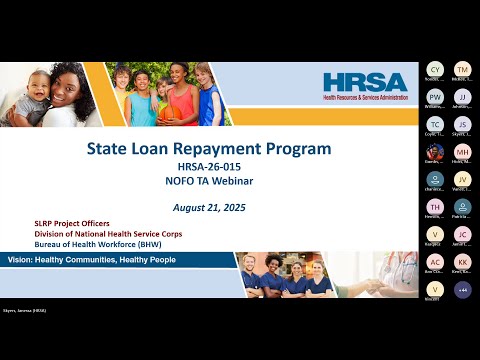
HRSA held a webinar explaining the State Loan Repayment Program NOFO, application requirements, matching rules, and Q&A; agency officials said they expect to award about $20 million to up to 50 grantees over three years, with a projected July 1, 2026 start date.
The Health Resources and Services Administration hosted a technical‑assistance webinar on the State Loan Repayment Program (SLURP) notice of funding opportunity, walking applicants through eligibility, application forms and budget requirements and answering participant questions. HRSA officials said the agency expects to award approximately $20,000,000 to up to 50 grantees over a three‑year project period.
Jessica Anne Johnson of the Bureau of Health Workforce said SLURP provides cost‑sharing grants to states and other eligible entities to operate loan‑repayment programs for primary care and other eligible disciplines in federally designated health professional shortage areas. "HRSA will award approximately $20,000,000 up to 50 grantees over a 3 year period," she said. She also reminded applicants that the program was established under Title II of the Public Service Act and cited regulatory guidance at 42 CFR 62.22.
Why it matters: the NOFO requires a dollar‑for‑dollar nonfederal match for federal award dollars, and states have flexibility in what they count as match (state appropriations, foundations, site contributions and other nonfederal sources). HRSA staff emphasized that only one applicant may apply on behalf of each state, and that states may designate another entity (for example, a university or primary care office) to administer the program if they supply a memorandum of understanding documenting that relationship.
Application and budget details: Timothy Cole, listed in the webinar materials as the grants management specialist, reviewed form SF‑424 entries, the UEI (unique entity identifier) and EIN fields, and the requirement to submit separate budgets for each of the three project years. Cole advised applicants to list key personnel (at minimum the project director and the authorized official) and other support staff names in the application; if salary costs are not being requested, HRSA advised entering zero in the requested salary fields. "I don't think we have a preference... I would put 0 then," Cole said when asked how to reflect salary lines the program will not fund.
Program priorities and scoring: Portia Williams summarized the four SLURP critical elements—participant eligibility; discipline eligibility; practice site eligibility; and program administrative management and oversight—and the five review criteria that total 100 points (purpose and need; response and work plan; impact, including monitoring and evaluation; resources and capabilities; and requested support). Applicants were urged to describe workforce gaps, HPSA coverage, plans for evaluation and data management (including NPI reporting), and sustainability beyond federal funding.
Q&A highlights and policy clarifications: HRSA confirmed that telehealth policies may be mirrored by state programs but cannot be more favorable than National Health Service Corps allowances (an example of a 75% telehealth allowance was discussed). HRSA reiterated that federal SLURP funds may be used only for awards (federal dollars cannot be used for administrative costs) while states may apply state dollars to administrative needs. Officials also confirmed that no retroactive or previously incurred costs will be allowable under the grant vehicle; "no retroactive payments are allowable either," a grants official said in response to a question about retroactive state programs.
Funding levels and timing: HRSA indicated the program allows up to $1,000,000 per year for a grantee (for each of three years) and noted maximum award amounts for service commitments: up to $75,000 for primary‑care disciplines for a two‑year full‑time service obligation, and up to $50,000 for dental and mental‑health providers for two‑year full‑time obligations. HRSA said the new project period is expected to begin July 1, 2026, the NOFO closes January 12, and notices of award are planned for early spring following objective review.
Contacts and next steps: speakers asked attendees to review the full NOFO for detailed subpoints, to include any required attachments (for example, MOUs) in applications, and to direct follow‑up questions to the SLURP mailbox (slurp@hrsa.gov) or the Division of External Affairs. Webinar slides and the recording will be posted on HRSA's website.
The NOFO webinar closed after additional participant questions and a reminder of upcoming TA sessions ahead of the application deadline.