Get Full Government Meeting Transcripts, Videos, & Alerts Forever!
Get email alerts on the Science Physics Axion Searches topic
No spam. Unsubscribe anytime.
SLAC lecture: Panofsky Fellow Chelsea Bartram outlines radio-based searches for axion dark matter
Summary
At a public SLAC lecture, Chelsea Bartram described how experiments such as ADMX and the DM Radio family use tuned resonators, strong magnets and quantum amplifiers to search for axion (wave-like) dark matter, outlined technical challenges and fielded audience questions on bandwidth, interference and theory connections.
Chelsea Bartram, a Panofsky Fellow at SLAC National Accelerator Laboratory, explained how physicists are using tunable, radio-like detectors and very strong magnets to hunt for axions — a leading wave-like dark-matter candidate — at a public lecture on Feb. 27.
Bartram opened by defining dark matter as an invisible substance that accounts for roughly 85% of the universe’s mass and said axions would behave more like waves than ordinary particles. "Dark matter is an invisible material that makes up 85% of the mass of the universe," she said, adding that axions would convert to photons in a magnetic field and produce a narrow, identifiable peak in a detector’s power spectrum.
Her talk described two experimental approaches. Cavity haloscopes — typified by the Axion Dark Matter eXperiment (ADMX) at the University of Washington — use a copper cavity placed inside an ~8-tesla magnet, cooled to millikelvin temperatures and read out with quantum amplifiers to search narrow frequency bands. "We then place a wire into the cavity, and it picks up that signal," she said, explaining how a resonant peak can be converted to an axion mass. Bartram said ADMX has probed parts of the theoretically motivated region for the QCD axion but has not found a signal to date.
The second approach is the DM Radio family of lumped-element experiments, which use large inductors in toroidal magnets and superconducting SQUID (superconducting quantum interference device) readouts to reach lower frequencies (lower axion masses). Bartram described DM Radio 50 L — sited at Stanford for near-term commissioning — and outlined plans for a "meter-cubed" upgrade and a larger DM Radio GUT instrument. She said the DM Radio meter-cubed device is planned to be sited at SLAC to push sensitivity toward parts of the QCD-axion band.
Bartram stressed three experimental levers that determine search speed and sensitivity: magnet strength (signal scales approximately with magnetic field squared), detector volume and the resonator quality factor (Q). She described practical tools — dilution refrigerators to reach sub-Kelvin temperatures and quantum amplifiers that add minimal noise — that enable sensitivity to extremely small signal powers.
During audience questions she addressed bandwidth trade-offs, terrestrial radio interference and theoretical implications. Asked why detectors cannot simply cover larger bandwidths, Bartram explained a fundamental constraint for passive linear, time-invariant systems: broadening bandwidth typically lowers sensitivity. She noted teams try active circuits and other engineering solutions but said increasing magnet strength and resonator Q remain key to improving scan rate. On interference, she described standard verification methods — magnetic-field localization, on/off tests and cross-checks in cryogenic environments — that distinguish environmental signals from genuine axion-like events.
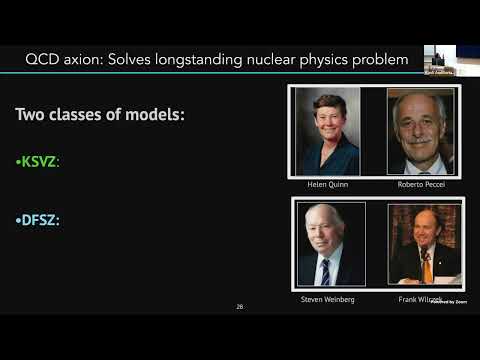
Bartram also discussed how a detected axion would be followed up: experiments would take long-duration, high-resolution data at the resonant frequency to map the local "dark-matter wind" and study the signal shape and slow frequency shifts. She acknowledged theorists in the room (including Helen Quinn) and said reaching DFSZ and KSVZ benchmark sensitivities would probe physics connected to grand-unified-scale models.
The lecture closed with a reminder that advances in quantum information science and particle astrophysics are accelerating the field’s experimental capabilities. The moderator invited attendees to continue the discussion in the lobby.