Get Full Government Meeting Transcripts, Videos, & Alerts Forever!
Get email alerts on the Zoning Variance topic
No spam. Unsubscribe anytime.
Board of Adjustment approves variance to split 106 West Peach Street despite 75‑square‑foot shortfall
Summary
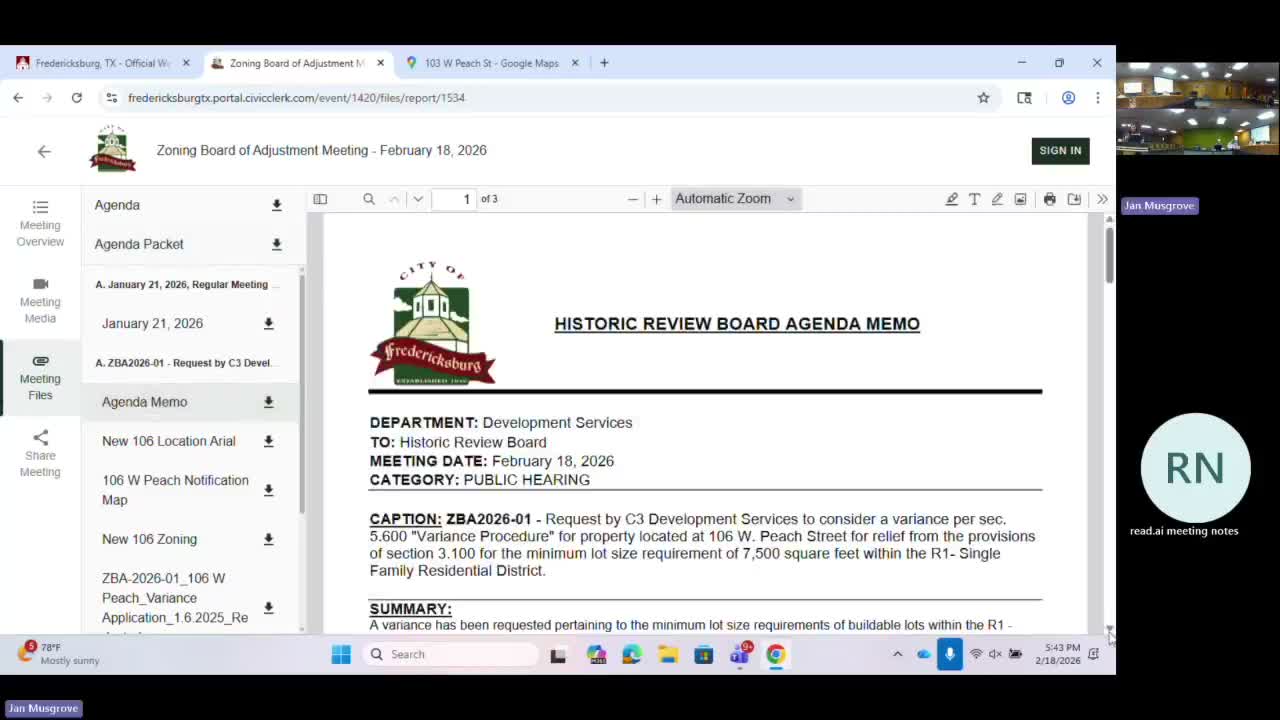
The Fredericksburg Board of Adjustment approved CVA 202601, a variance allowing subdivision of 106 West Peach Street into two lots even though one resulting lot would be about 75 square feet under the R‑1 district minimum of 7,500 square feet. The board found the shortfall was a preexisting condition and the variance would not alter neighborhood character.
The Fredericksburg City Board of Adjustment on a vote approved CVA 202601, granting a variance that allows the subdivision of the property at 106 West Peach Street into two lots despite one lot falling roughly 75 square feet short of the R‑1 minimum of 7,500 square feet. Vice Chair Eric Hamerson called the motion after an applicant presentation and board deliberation, and the chair announced the motion passed.
Shelby Holder, the applicant’s representative, testified under oath that the ownership bought the parcel in 2016 and discovered, during a recent survey, that the tract was about 75 square feet shy of the R‑1 lot‑size requirement. Holder said the lot “seems set up already for 2 residences,” pointing to two existing curb cuts and an historical outlot remainder that the ownership attempted but failed to claim through survey/county processes. Holder told the board the owner intends to build on the newly created lot.
Staff cautioned the board about the legal consequences of creating a nonconforming lot. Staff explained that the split would likely produce one buildable lot and one legal nonconforming lot; under the code’s replacement provisions, if a nonconforming structure is completely destroyed, it may not be rebuilt except in conformance with current ordinance provisions. Staff urged the applicant to understand those limitations and noted that nonconforming rebuild and termination provisions should factor into the board’s findings.
Board members questioned the applicant and staff about prior platting, whether the city had previously authorized access or curb cuts, and about the size and frontage of neighboring lots. The record shows survey work identified an unclaimed outlot totaling a little over 100 square feet (applicant cited roughly 116 sq ft) that, if acquired, might have removed the need for a variance but which the applicant said was not obtainable. The survey presented to the board showed the two proposed lots would have frontages of approximately 76 feet and 74 feet, respectively.
During deliberation several members said they believed the owner did not create the hardship and that the variance would not alter the character of the adjacent properties. Relying on the board’s three findings of fact for variances — that the regulations prevent reasonable use, that the owner’s plight is due to unique circumstances not created by the owner, and that the variance will not alter the area’s character — members supported approval. A motion to approve was made, seconded, and the chair announced that CVA 202601 was approved.
The board also discussed broader remedies for similarly situated lots, including possible nonconforming‑use rebuild amendments, administrative minor‑variance thresholds for small dimensional errors, and the complexity of any mass rezoning. Staff noted the city has initiated a Unified Development Code process to consider code updates and other text amendments.
The board’s action grants the specific variance requested in CVA 202601. The approval does not alter the code’s replacement or termination provisions for nonconforming structures; the applicant and future owners remain subject to those rules.