
House Finance hears bill to roll back 2025 estate-tax rate increases
Get AI-powered insights, summaries, and transcripts
Subscribe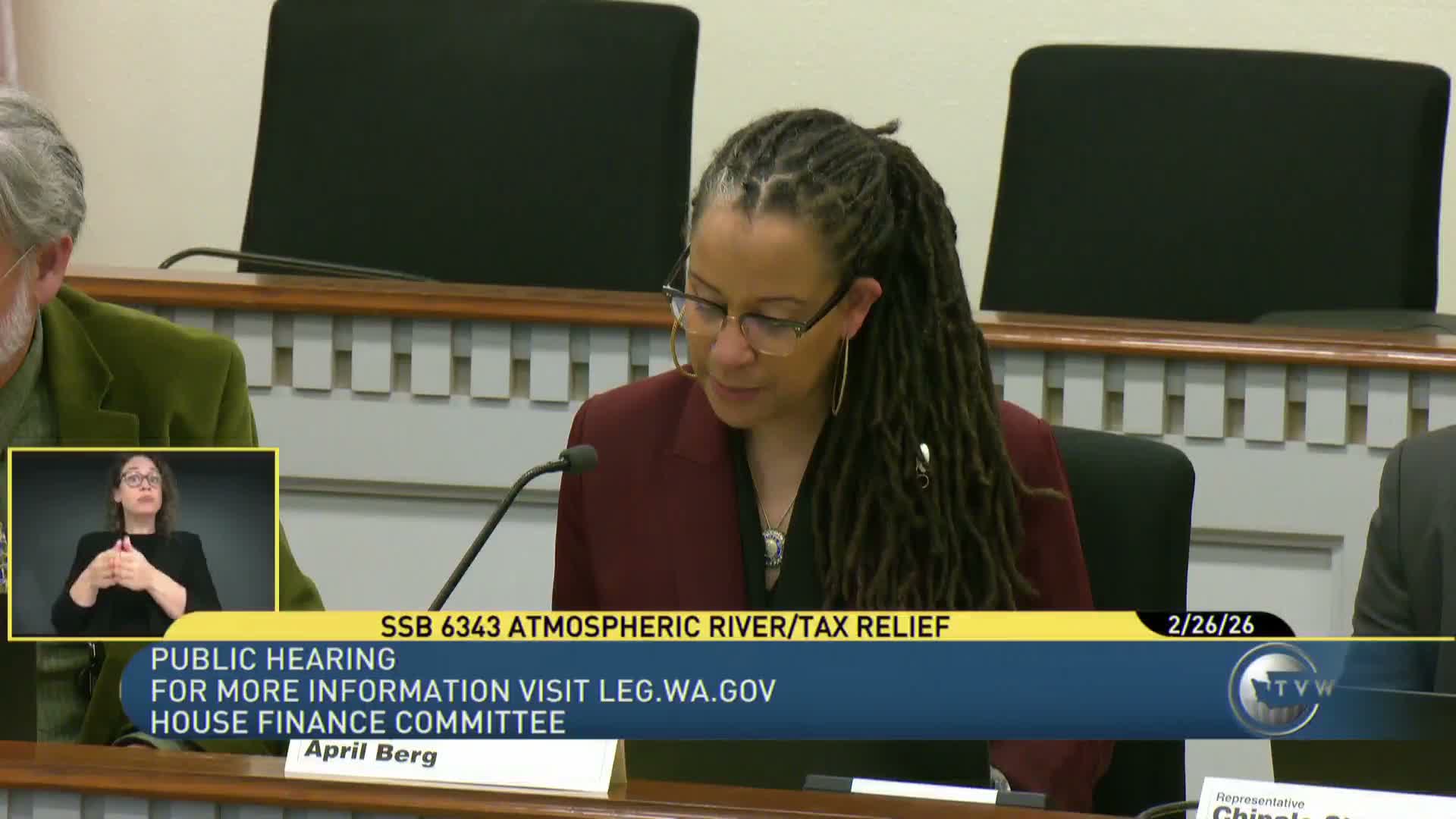
Summary
The House Finance Committee heard Senate Bill 6347, which would revert estate-tax rates enacted in 2025 to prior levels beginning for decedents dying on or after July 1, 2026. Testimony split between advocates for revenue stability and proponents of relief for estates and family businesses.
The House Finance Committee on Feb. 26 heard Senate Bill 6347, a measure to restore estate-tax rates that were increased in 2025. Committee staff said the bill returns the graduated rate schedule to roughly 10–20% for decedents dying on or after July 1, 2026, while keeping the CPI-based exclusion adjustment.
Tracy Taylor, committee staff, told the committee the bill would reduce revenues to the Education Legacy Trust account beginning in fiscal year 2027 and that a fiscal note is available on the legislative fiscal files.
Public testimony split sharply. John Burbank urged lawmakers to vote against the bill, saying the rollback would primarily benefit very wealthy households and citing large budget impacts and program cuts; he told the committee the change would “pull $200,000,000 a year from the state budget” and argued it would divert funding from education and early-learning programs.
Opponents from policy and fiscal groups urged caution. Ryan Watt, executive director of the Economic Opportunity Institute, said revenue impacts are difficult to predict because estate-tax receipts depend on timing of deaths, and warned the rollback could reduce roughly $400 million in revenue in a future biennium. Mia Shigemura of the Washington State Budget and Policy Center said the bill would create a larger benefit for wealthy households by combining lower rates with the higher exemption threshold set last year; she cited an estimate of about $45 million in current-year reductions and roughly $400 million in ongoing biennial reductions.
Business and agricultural interests testified in favor. Tim Overland, CEO of the Nelson Legacy Group, described how the estate-tax structure could impose liquidity pressures on multigenerational family businesses when an owner dies and urged lawmakers to support SB 6347 to avoid forced sales or other disruptions.
Representatives asked staff to confirm that the CPI adjustment remains in the bill; staff confirmed the CPI-based exclusion remains but that the rate schedule would revert. Several members said they were concerned about making significant tax changes while the state faces budget pressure.
The committee closed the public hearing without recording a vote; the bill will proceed according to the committee’s scheduling rules.