Get Full Government Meeting Transcripts, Videos, & Alerts Forever!
Get email alerts on the Committee Business topic
No spam. Unsubscribe anytime.
Wyoming advisory committee approves next panelists, seeks more local testimony
Summary
After hearing HUD and university presentations, the advisory committee approved a prioritized list of community‑panel invitees by voice vote and invited additional public comment and written submissions, saying further testimony will inform the committee's report to the U.S. Commission on Civil Rights.
The Wyoming Advisory Committee to the U.S. Commission on Civil Rights approved a prioritized approach to selecting panelists for its next briefing during the March 24 meeting. Chair Mister O'Brien proposed a list with Peter Christiansen and Mary Therese Gorsky as first priorities, followed by four community advocates (Jason Wells, Melissa Ray Theroux, Raymond Macchia and Bria Grama) and two alternates (Brenda Burkel and Dan Dorsch). Committee member Jimmy Simmons moved to approve the plan; Virginia Arbery seconded and the committee approved the motion by voice vote.
Public comment: Laurie Irvakad, government affairs director for the Wyoming Realtors, told the committee the 2015 Wyoming Fair Housing Act was drafted to be substantially equivalent to the federal Fair Housing Act and said her organization will pursue discussions with the governor's office about establishing a state enforcement entity so residents can file locally rather than through HUD. "When we wrote that legislation in 2015, it was substantially equivalent to the Federal Fair Housing Act," Irvakad said.
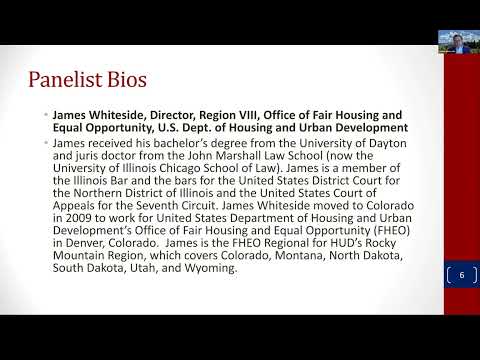
HUD response and certification pathway: James Whiteside of HUD answered questions about whether state statutory text must explicitly enumerate sexual orientation and gender identity to qualify for federal Fair Housing Assistance Program certification. He said HUD looks for substantive rights consistent with federal interpretation (including protections HUD applies after Bostock v. Clayton County) and that an enforcing agency’s interpretation and a memorandum of understanding with HUD can satisfy the certification standard.
Next steps and staff work: Committee members asked staff to contact proposed panelists, prioritize those who had previously been invited, and report back on confirmations at the next meeting. The committee plans follow‑up briefings to solicit community advocates and affected individuals to supplement federal and academic testimony.
Ending: The committee adjourned and scheduled a May meeting to continue the fact‑gathering process for its advisory report to the U.S. Commission on Civil Rights.