Get Full Government Meeting Transcripts, Videos, & Alerts Forever!
Get email alerts on the Hwy Improvements topic
No spam. Unsubscribe anytime.
Holly Springs council approves engineering contract for Holly Street walkability project amid resident questions on annexation and costs
Summary
On Feb. 2, Holly Springs City Council approved a Michael Baker International engineering agreement to design Holly Street improvements under a Livable Centers Initiative grant, after residents raised questions about the project's need, transparency and potential annexation impacts; staff said the project is 80% federally funded.
Holly Springs City Council voted unanimously Feb. 2 to authorize an engineering agreement with Michael Baker International to design improvements on Holly Street as part of a Livable Centers Initiative (LCI) project intended to increase downtown walkability.
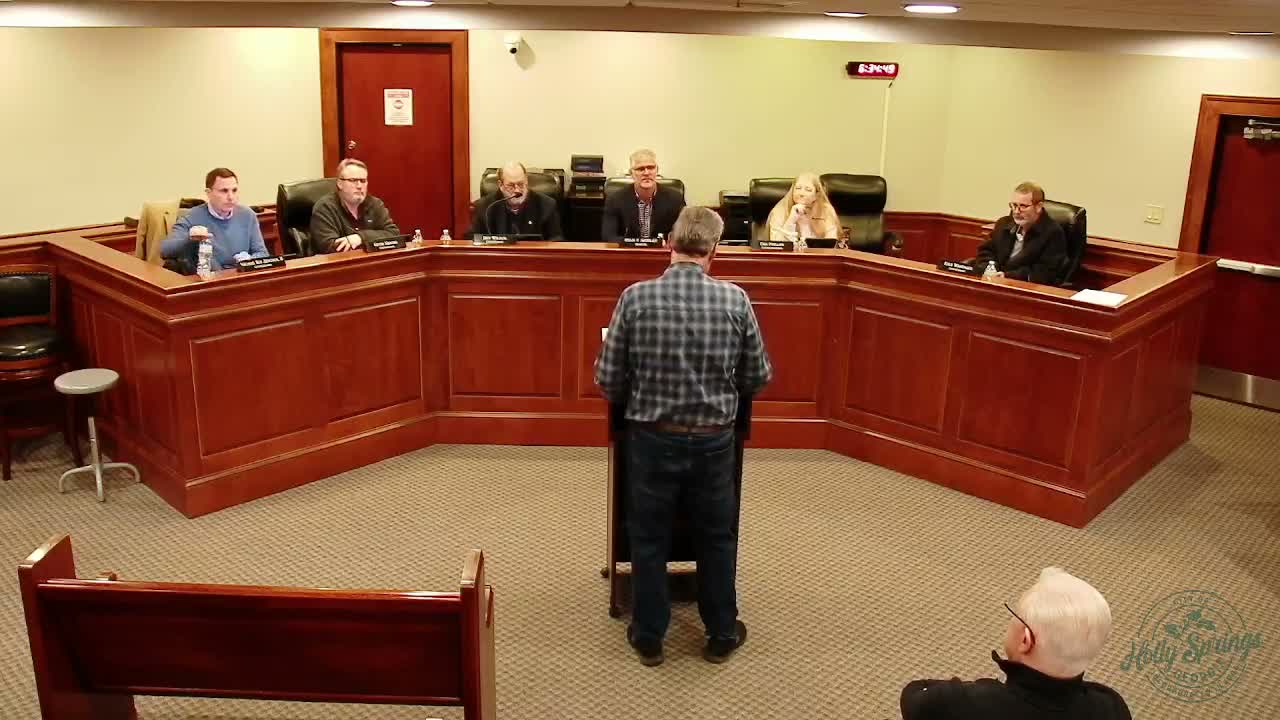
Residents criticized the project during the public-comment period. Warren Bailey, who said he lives on Kimberly Place in "West Holly Springs," asked: "Who asked for this? Why are we doing this?" He called for greater transparency and questioned whether the engineering study and eventual construction would serve nearby neighborhoods or primarily benefit new development.
City staff explained the project background during the meeting. A staff presentation said the city applied for LCI funds through the Georgia Department of Transportation several years ago to add pedestrian connectivity where sidewalks are currently lacking on Holly Street; because the bridge over the interstate cannot accommodate a sidewalk, the project looks to provide alternative walkability connections. Staff described the funding as federal money passed through GDOT, with an 80% federal share and a 20% local match.
The agenda listed the agreement amount "not to exceed $477,003.19," but staff later cited the fiscal impact as $477,319.01; the council approved the agreement and authorized the mayor to execute the contract upon city-attorney approval. The project was identified by GDOT PI number 0019206 (also shown in the agenda packet as PI 19206).
The meeting also included concerns tied to annexation and zoning. Several residents pressed the council on annexation, de-annexation and so-called "spot zoning" practices; council members and staff emphasized they follow the city's legal growth-boundary agreement and that annexations proceed through planning, public hearings and other standard steps. An unnamed police official warned the council that a hypothetical de-annexation of roughly 20% of the city's area could reduce staffing by an estimated eight officers (from 40 to 32), slow response times and reduce proactive policing, a point made to underscore public-safety trade-offs tied to boundary changes.
After the discussion, the council moved to approve the Michael Baker International agreement and voted 5-0 to carry the motion.
The city provided no precise project construction timeline or an engineering schedule in the meeting; staff indicated they will return with additional details as design advances and legal approvals are finalized.