Get Full Government Meeting Transcripts, Videos, & Alerts Forever!
Get email alerts on the Tree Replacement Groundwater topic
No spam. Unsubscribe anytime.
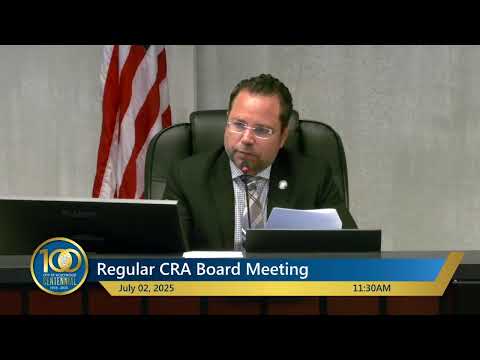
CRA to test groundwater after hundreds of palms fail on Hollywood Boulevard
Summary
After a multi‑year streetscape planting, CRA staff reported 178 palms were installed on Hollywood Boulevard; 127 survived while 31 perished. Staff recommended limited geotechnical monitoring to determine whether to replant or permanently pave over 13 problematic pits.
The Community Redevelopment Agency on Thursday reviewed the results of a multi‑year streetscape planting on Hollywood Boulevard and endorsed a limited groundwater monitoring test before deciding whether to replant dozens of failed palms.
In a presentation, project staff summarized planting results: “So in summary, we had a 178 palms altogether along the project. A 127 survived and are are relatively thriving. We have 31 that have, perished, that will be replaced either in a new planting strip or in the planters with the new gravel detail,” the presenter stated. Staff also said nine replacement trees have been installed so far and seven dead palms on the north end will be permanently removed and paved over.
The board heard three options for handling 13 tree pits where subsurface conditions are uncertain: abandon and pave over the pits; install shallow PVC monitoring pipes (a low‑cost “dipstick” method) and check levels periodically; or install instrumented 8– to 10‑foot geotechnical wells with telemetry. Staff gave order‑of‑magnitude costs: the PVC/dipstick option would be the cheaper alternative (roughly several thousand dollars over a six‑month monitoring period), while fully instrumented wells would run about $7,000–$8,000 each and two wells could total about $12,000.
Commissioners pressed staff on two financial questions: who pays for repeated replanting if trees die again and whether one monitoring well would yield data useful for other problem areas. Susan (CRA staff) and other staff said warranty language covers some replacements, contractor contingencies can cover other work, and one well placed in a representative problem grouping would provide actionable salinity and fluctuation information the CRA could extrapolate to nearby pits.
Commissioner Hernandez raised technical concerns about pit dimensions and drainage, asking whether many pits are 24‑inch versus 36‑inch openings and arguing that restricted root space and poor drainage — not only the choice of species — are major contributors to failure. Hernandez said the council must weigh the monitoring cost against the value of the trees and the cost of repeated replacements.
Board members expressed broad agreement to proceed with monitoring as a final data step before more permanent decisions. Staff characterized the monitoring as a way to decide whether to replant using the arborist’s new gravel and tree‑grate detail or to repave problem pits if replanting fails again. The board did not adopt a binding policy change at Thursday’s meeting; staff will return with monitoring logistics and cost estimates for a single monitoring well and with the status of ongoing replanting efforts.
What’s next: staff will pursue the recommended monitoring trial and continue the current replanting program where staff and the arborist believe replacements have a good chance of survival. The board indicated it will reassess and direct whether additional pits should be paved over or reinstalled after receiving monitoring data.