Get Full Government Meeting Transcripts, Videos, & Alerts Forever!
Get email alerts on the Court Hearing Pv topic
No spam. Unsubscribe anytime.
Court allows substantive due-process claim to proceed for 10-year-old; gives plaintiffs three weeks to amend
Summary
A Michigan Court of Claims judge ruled that a substantive due-process claim by a 10-year-old identified as PV may proceed and granted plaintiffs three weeks to file an amended complaint adding a statutory claim under MCL 330.1722 as an alternative remedy; the court rejected dismissal under governmental-immunity arguments at this time.
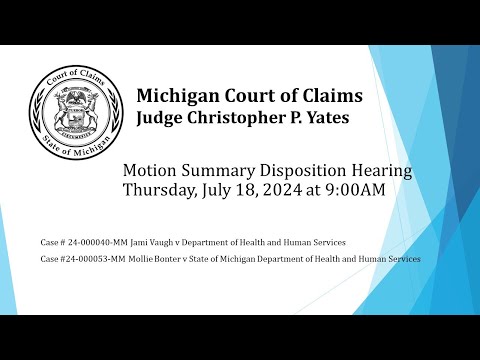
A Michigan Court of Claims judge on a motion hearing reviewing two related suits involving alleged assaults at a state psychiatric facility said plaintiffs in the PV matter may amend their complaint and allowed a substantive due-process claim to proceed.
The judge described PV as a 10-year-old who was assaulted while in the facility and said he would grant plaintiffs three weeks’ leave to file a second amended complaint "pleading in the alternative a constitutional claim or claims, and…a claim under the statute, MCL 330.1722." The order is intended to avoid forcing plaintiffs into a Hobson’s choice between a statutory remedy and a direct constitutional action if the adequacy of the statutory remedy remains unclear.
Why it matters: defendants had asked for dismissal under MCR 2.116(c)(7) and (c)(8) based on governmental immunity and failure to state a claim. The judge repeatedly referenced the Michigan Supreme Court’s decision in Bauserman, which recognizes money damages for direct constitutional violations unless another branch has provided an adequate remedy. The court said it could not yet determine whether a statutory claim under MCL 330.1722 would be an adequate substitute when money damages under the statute might be barred by governmental immunity.
What the parties argued: Scott Rockman, counsel for the Michigan Department of Health and Human Services, told the court the department would rely on the governmental tort liability act (GTLA) and argued that the mental-health-code provision MCL 330.1722 "gives plaintiffs an avenue to pursue injunctive and other appropriate civil relief," presenting it as an adequate statutory remedy. Stacy Hinolet, representing the plaintiffs, said the plaintiffs rely on video obtained through FOIA and argued the statutory route is not an adequate substitute because prior authority (Dockweiler and related reasoning) shows monetary relief under that statute can be limited by governmental-immunity defenses.
Court’s legal reasoning in brief: the judge applied the c.8 pleading standard from El Khalil and other authorities: a motion under MCR 2.116(c)(8) tests legal sufficiency and requires accepting factual allegations as true at the pleading stage. The judge said the PV complaint, taken as true, did not clearly state a Fourth‑ or Eighth‑Amendment analog claim but did contain sufficient factual allegations to support a substantive due‑process claim. Because of uncertainty about whether a statutory claim would remain effective in practice, the judge denied summary disposition under c.7 for now and allowed plaintiffs a targeted opportunity to amend.
Next steps: plaintiffs have three weeks to file a second amended complaint alleging, at minimum, (1) a substantive due‑process violation and (2) a claim under MCL 330.1722. Defendants may file renewed motions for summary disposition in response to any amended pleading, and the judge said he will issue written orders and fuller opinions on the remaining issues.
For attribution: quotes are from courtroom argument. Scott Rockman spoke for the Department of Health and Human Services; Stacy Hinolet represented the plaintiffs; the presiding judge (name not stated on the record) made the rulings. The judge read the complaint counts aloud and referenced Michigan Supreme Court precedent Bauserman in explaining the rationale.
The hearing also addressed venue and which defendants remain in Wayne County Circuit Court versus the Court of Claims, and the court invited the parties to stipulate scheduling extensions where necessary.