Get Full Government Meeting Transcripts, Videos, & Alerts Forever!
Get email alerts on the Discovery Interrogatories topic
No spam. Unsubscribe anytime.
Court takes defendants’ motion to compel signatures on interrogatory answers under advisement in mass Wixom Lake litigation
Summary
At a July 29 hearing in the Michigan Court of Claims, defense counsel urged that plaintiffs must sign interrogatory answers rather than rely on attorneys; plaintiffs said the case management order, standardized fact sheets and recent state document productions make collecting individual signatures impractical. Judge Redford took the motion under advisement, ordered a short meet‑and‑confer letter, and said he will issue an order within two days.
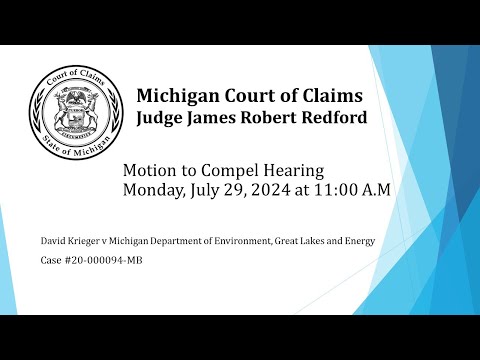
Judge James Redford took under advisement a defense motion to compel plaintiffs to sign answers to interrogatories in the consolidated litigation over the Wixom Lake dam failure after oral argument on July 29 in the Michigan Court of Claims.
The dispute centers on whether the court rules require individual plaintiffs — rather than only their attorneys — to sign interrogatory responses. Nathan Gamble, appearing for the defendants, told the court the Michigan court rules require plaintiffs to sign interrogatories and that the case management order (CMO) did not alter that signature requirement. Gamble said many of the interrogatories seek factual information and identification of witnesses and that allowing attorneys to serve as de facto fact witnesses would create ethical and evidentiary problems.
Lead plaintiffs’ counsel Sharon Almonrod responded that the CMO already replaced burdensome individual initial disclosures with standardized fact sheets to accommodate roughly 1,850–2,000 plaintiffs and that many of the contested interrogatories ask for technical factual detail that only expert witnesses can provide. Almonrod said her teams only recently received large state document productions — some material previously held by FERC — that experts must review before plaintiffs can provide the kind of verified responses the defense seeks.
Judge Redford reviewed the tight schedule in the case and the proximity of expert deadlines, noting discovery closes on 2025‑01‑31 and that plaintiffs had recently served expert identifications. He urged counsel to narrow the dispute where possible to avoid procedural burden and to preserve the schedule for expert and fact discovery.
To resolve the immediate procedural question, the court instructed lead defense and lead plaintiffs’ counsel to confer by phone the same day and to file a short letter to the clerk identifying which of interrogatories 1–14 the parties agree are not appropriately directed to individual plaintiffs and which remain in dispute. The judge asked that the letter be filed by the end of the next business day or by midday Wednesday and said he expects to issue a written opinion and order within two days after receiving that submission.
The hearing record shows defense counsel argued some interrogatories (including requests identified in argument as Nos. 7–9) seek straightforward factual material — for example, who provided information that certain events occurred — and that, if plaintiffs lack any witnesses or documents supporting those allegations, the plaintiffs should remove those allegations from their complaints. Plaintiffs said such factual assertions are building blocks for expert opinions and that they are working to authenticate and analyze recently produced materials.
No formal ruling was made at the hearing; the court’s next procedural step will be the short letter from counsel and then the court’s forthcoming order.